
Philadelphia’s Cooper Volunteer Saloon Revisited
Originally published September 2022 · pp. 34–35
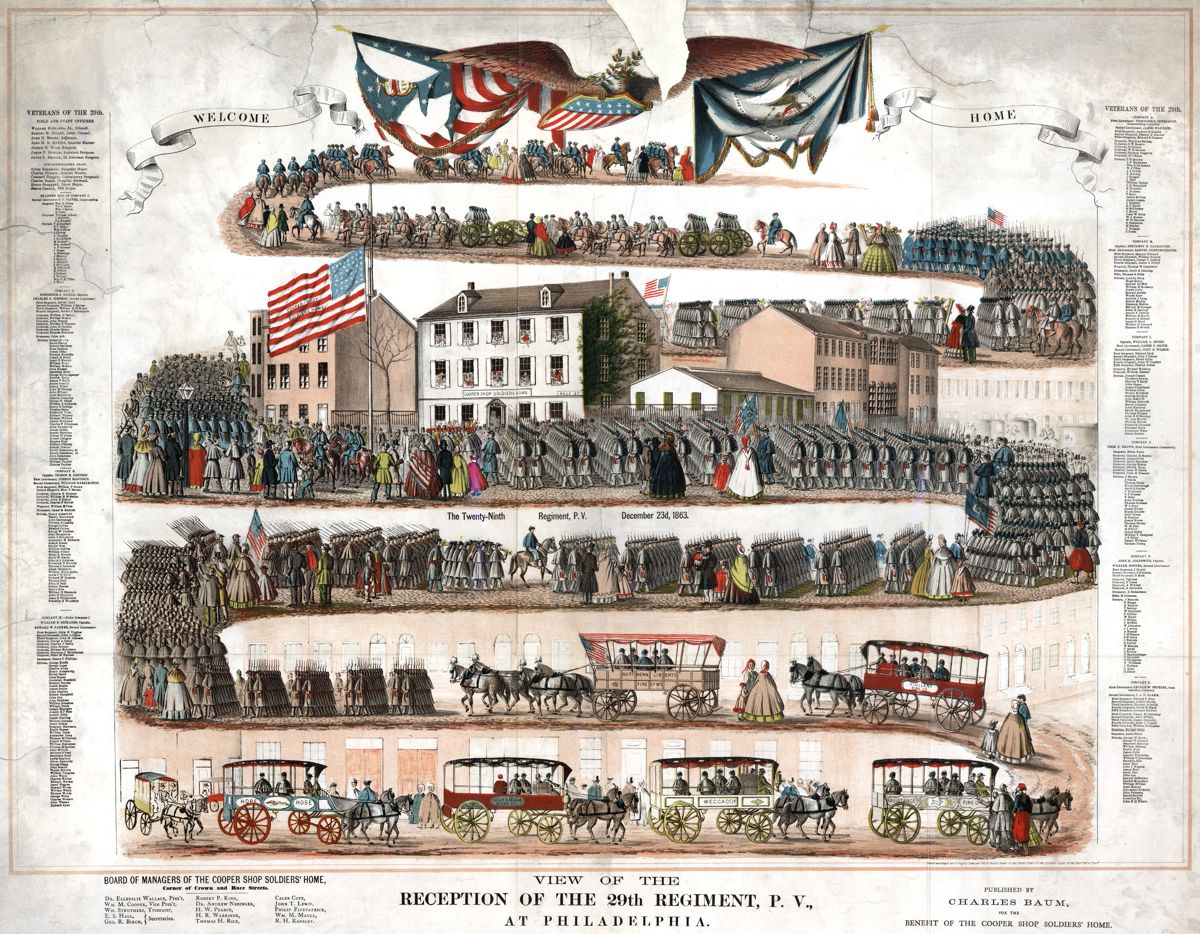
Philadelphia’s Cooper Volunteer Saloon Revisited The Graphic War highlights prints and printmakers from the Civil War discussing their meaning and the print maker or artist’s goals. A year ago, this past August we featured a lithograph produced by artist James Queen and published by Thomas Sinclair. It depicted the Volunteer Saloon of
Philadelphia founded by South Philadelphia grocer Barzilla S. Brown who began by passing out food to transient soldiers on their way to the front. Last month we featured a collaborator and/ or competitor, the Cooper Shop Volunteer Refreshment Saloon located in close proximity to Brown’s “USO.” This month we highlight an extremely unusual print lithographed by Charles Baum highlighting the latter. The print features the Cooper Shop establishment and was intended to be a fund raiser for the Saloon. Like many other German immigrants gifted with the ability to produce art, Baum came to America to ply his trade. He was born ca. 1824 and settled in Philadelphia. During the Civil War, he produced prints of Union camps around Philadelphia; Camp Meigs in 1861, Camp Brandywine, and Camp Dupont the following year. Little is known of his personal life except that he lived with his second wife, Elizabeth, and a daughter (b. ca. 1849) at Second Street above Ontario Street (Ward 23) in 1860 in Philadelphia.1 Baum’s purpose in producing this remarkable print was to honor the 29th Pennsylvania.
“On the 23rd of December, 1863, the officers and men of the 29th Pennsylvania regiment, Col. Rickards, returning after three years’ service, were entertained at the Soldier’s Home, where nearly three hundred, officers and men, enjoyed a bountiful dinner.” So wrote the Cooper Union’s historian, Dr. James Moore.2 The 29th, a three-year regiment, proudly served in both theaters of the war. It mustered in at Philadelphia in July 1861, for three years, and reenlisted as a veteran regiment. Its total strength was 2,517, of whom 147 were killed or died of wounds. It was present but unengaged at Cedar Mountain and Antietam. It missed the battle at Fredericksburg but participated in the Chancellorsville campaign and the battle of Gettysburg. In February 1862, the regiment was in a skirmish where its organizer and commander Colonel John Murphy was captured. “On
View of the Reception of the 29th Regiment, Pennsylvania Volunteers, at Philadelphia.(Library of Congress)
Sept. 23, 1863, the regiment was ordered west and reached Murfreesboro, Tenn., Oct 5. The troops conducted themselves heroically at the battles of Wauhatchie, Lookout mountain [sic] and Ringgold and through all the hard service of the army on its way to Atlanta, remaining with the army of Gen. Sherman until the end…”3 This historically rich print contains a myriad of images beginning with the overwhelming, snaking procession of the 29th Pennsylvania moving in seven levels to the top, which is surmounted by a large eagle holding an American shield. On either side of the eagle are patriotic banners, which read “Welcome Home.” The American flag on the left is torn as is the regimental flag on the right. Yet, both are proudly displayed. Leading the procession are soldiers on horseback “followed by infantrymen transported in horse-drawn wagons….and a small brass military band. After the musicians, the 29th …. marches on foot, with some men carrying flags. Intermixed with the marching soldiers are additional military bands and officers on horseback.” The parade began “at about one o’clock from Market Street Bridge down Market Street to Twenty-First Street, eventually arriving at the Cooper Shop Soldiers Home, where the members of the 29th regiment had dinner before proceeding to the National Guards Hall (518520 Race Street) to be welcomed by Colonel John Price Wetherill.” The title margin contains the artist’s name on the lower right and the names of the Cooper Shop’s directors on the left. In the middle of the busy print is the dedication to the 29th Pennsylvania and also a depiction of Cooper’s new “Soldiers Home.” On both side margins “are the names of the ‘Veterans of the 29th,’ listing the field and staff officers, the noncommissioned officers, and each company, including the African American Company K.” The artist’s depiction of a Civil War regiment is overwhelming until one realizes that several other units of civic origin are also included. Artist Baum chose to incorporate local fire companies in the parade including the “Northern Liberty Fire Company, Number 1; Vigilant Fire Company; Assistance Fire Company, Weccacoe; Southwark Hose Company; and Hope Hose Company.” In addition, the crowded scene included “the First City Troop; 27th New York Battery; Liberty Coronet Band; Henry Guards; four companies of invalids corps; Provost Guard; discharged members of the regiment; Birgfield’s Band; former (Murphy) and present (Rickards) commander of the regiment; Lieutenant Colonel Zulick of the regiment; the regiment; female family members; First Regiment; Jefferson Coronet Band; Pennsylvania Military Institute cadets; City Council members; other guards and regiments; and lastly, the ambulances of the firemen.”4 The great reveal came during the day when it was announced that the veterans of the 29th would reenlist for another tour of duty. The regiment eventually mustered out near Alexandria, Va., July 17, 1865. Endnotes: 1. Philadelphia on Stone Biographical Dictionary of Lithographers. The Library Company of Philadelphia, Charles Baum, https:// d i g i t a l . l i b r a r y c o m p a n y. org/islandora/object/ digitool%3A78824. See also Harry T. Peters, America on Stone, 91. 2. History of the Cooper Shop Volunteer Refreshment Saloon, James Moore, MD, Philadelphia, 1866, p.96. 3. The Union Army, vol. 1, 368. 4. Cooper Volunteer Shop Saloon 29th Pennsylvania Notes, LoC description h t t p s : / / w w w. l o c . g o v / resource/gdcwdl.wdl_09526/ ?r=-0.008,0.199,1.015,0.72,0 After 43 years in the museum field, Cilella devotes his time collecting American prints and maps and writing. His most recent books are Upton’s Regulars: A History of the 121st New York Volunteers in the Civil War (U. Press Kansas, 2009). His two-volume Correspondence of Major General Emory Upton, (U. of Tennessee Press, 2017), received the 2017–2018 American Civil War Museum’s Founders Award for outstanding editing of primary source materials. “Till Death Do Us Part,” an edit of Upton’s letters to his wife 186870, was published in 2020 by the Oklahoma University Press.