
Mark Twain and the War (I) Sam Clemens, Confederate Deserter
Originally published September 2022 · pp. 26–27
Mark Twain and the War (I) Sam Clemens, Confederate Deserter “Twain in his later years was more Westerner and New Englander than Southerner, so that his work does not properly belong to this volume,” write the editors of The Literature of the South (1968 [1952]).1 That may be correct, but I’ve always considered Mark Twain to be a Southern writer, just one who retired to Connecticut. This is all the more true when one considers Sam Clemens’ brief experience in the Civil War. Clemens was born in Florida, in northeast Missouri, in 1835, of parents who traced their ancestry to early Virginia and Kentucky. When he was just a few years old they moved to the Mississippi River town of Hannibal. At the age of fourteen he started work as a printer’s apprentice. In 1857 he began serving as a steamboat pilot until the start of the war shut down river traffic.2 His parents, J. Marshall and Jane L., had been slaveholders in Missouri, albeit small ones (Jane brought two or three slaves into the marriage). Marshall, an attorney and judge, then acquired more as he could afford them. For her part, as Twain remembered in his Autobiography, Jane Clemens was a diehard Southern sympathizer who detested Yankees “with a splendid energy.” As crisis loomed in 1860, the young river pilot affirmed his Southern loyalties to family and friends. His niece remembered that “his sympathies were with the South.”3
Minnesota.6 The three weeks thus spent refreshed the writer’s inspiration, and it was also the only time Twain visited Civil War battlefields and talked extensively with Southerners about their war experiences. Samuel Clemens, however, had very few experiences to share. As he toured the South in 1882, Twain the Confederate deserter and converted Unionist probably felt uneasy among Southerners in whose conversations the war still figured so prominently. Twain’s task was in effect to distinguish between his actual war experiences and what he chose for others to know about them.7 His river-travel book, Life on the Mississippi, appeared in 1883. One sees in it Twain reflecting on what he had seen and heard in the South, essentially as an outsider looking in. He remarked, for instance, on Southerners’ fondness for “waw” talk. “In the South,” he wrote, “the war is what A.D. is elsewhere: they date from it. All day long you hear things ‘placed’ as having happened since the waw; or du’in the waw; or befo’ the waw; or right aftah the waw; or ‘bout two yeahs or five yeahs or ten yeahs befo’ the waw or aftah the waw.”
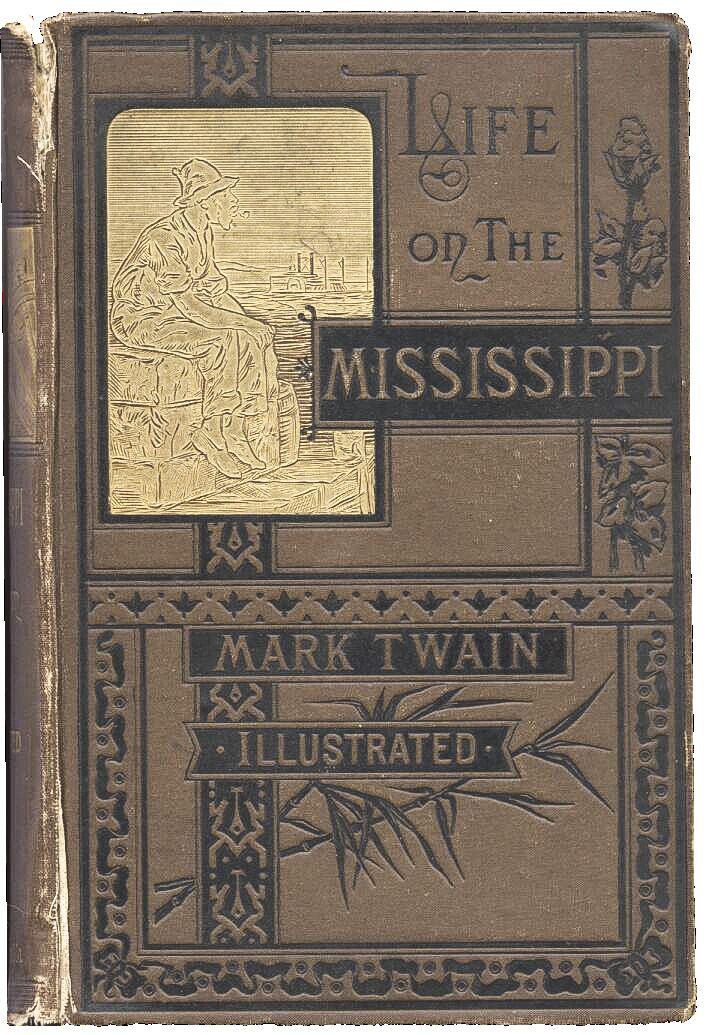
Thus it should come as no surprise that when some young men in Hannibal organized the Ralls County Rangers, Clemens (aged twenty-four) joined up and was elected second lieutenant. But after two weeks of dull drill and hiding from Yankees, Sam decided this kind of soldiering was not for him. When his brother Orion announced plans to take a job in Nevada Territory, Sam went with him. Settling in Virginia City, a hotbed of Southern sentiment (note the name), Clemens proudly claimed to have been a first lieutenant in the Confederate Army. When it came out that, as Arthur Pettit writes, “this Southern hotspur had actually been a second lieutenant of Missouri farm boys who spent most of their time retreating,” an embarrassed Clemens had to backtrack. By the spring of 1862 he had begun to morph into a Union sympathizer; six months after that he was railing in letters to friends against “the bastard confederacy” and predicting that a triumphant Union would soon be dictating terms “to submissive and groveling rebeldom.” 4 Thus was Sam Clemens’ conversion from Rebel to Yankee. His transformation from Confederate deserter to Unionist cheerleader became quite evident in his writing for the Virginia City Territorial Enterprise. It was in this newspaper that Clemens first signed himself as “Mark Twain,” Feb. 3, 1863.5 (The term, called out by riverboat leadsmen, meant that the river Book cover of Life on the was two fathoms—twelve Mississippi, 1883. feet—deep, and safe water for navigation.) At a dinner with some Twain’s conversion, however, gentlemen, Twain heard a story became a decided source of about how a young New Yorker discomfort twenty years later. had remarked to an elderly black In the early 1880s Twain was woman, “What a wonderful already an established writer, moon you have down here!” To with The Celebrated Jumping which she replied, “Ah., bless yo’ Frog of Calavares Cunty (1867), heart, honey, you ought to seen The Innocents Abroad (1869), dat moon befo’ de waw!” Roughing It (1872) and Tom One may well assume that Sawyer (1876). Around that time Twain felt uneasy about his he conceived the idea of a book desertion when he was among based on his youthful riverboat ex-Confederates. To assuage piloting experiences. To stock his conscience he sought to his imagination he revisited the come to terms with the war by Mississippi after two decades’ imagining for himself a role in it. absence. In April-May 1882 In Chapter XXXV in Life on the he travelled downstream from Mississippi, he literally tries to St. Louis to New Orleans become a survivor of the siege of and back upriver to St. Paul, Vicksburg. He toyed with the idea:
“…might not almost anybody reproduce for himself the life of that time in Vicksburg? Could you, who did not experience it, come nearer to reproducing it to the imagination of another nonparticipant than could a Vicksburger who DID experience it? It seems impossible; and yet there are reasons why it might not really be.” Believing it possible to reproduce in his imagination the ordeal of Vicksburg, and thus in a sense to impersonate a participant of the siege, Twain applies himself to the task of describing the bombardment as if he had been there to witness it. For two pages the shells crash vividly and dramatically, more dramatically, in fact, than in the diaries of actual observers. In the Vicksburg passage, though, one sees that Twain fails in his effort to bring the war to personal terms. As an alternative tactic he reduces its scope and import through one of his favorite devices, comic deflation. The story of Admiral Porter’s dummy ironclad is to Twain “a very large joke…a very funny joke indeed.” In his notebook Twain recorded the story of a Federal bombardment which after thirteen days had done nothing more than break the leg of an innocent dog. Twain added this quip: “It was a rebel dog. Claim for pension in Congress.” Typical of the author was his notebook entry in which he told of the Federal bombardment of Natchez in the comic dialect of an old darky. But as in his other attempts, he failed to achieve humor and to deflate his subject. Though he could not share experiences with noncombatants at Vicksburg, Twain seemed to search about for a means of relating himself to the war. His most successful effort, something one sees plainly in Life on the Mississippi, involves the war on the river. It is clear that all the river battles interested the author, though he had participated in none of them. The best Twain could do was to pad his own narrative with thinly concealed plagiarisms from standard histories. Accounts of the naval battle at Memphis and the fighting at Port Hudson were lifted straight from J. S. C. Abbott’s series, “Heroic Deeds of Heroic Men,” which appeared in Harper’s Monthly. Yet at times Twain showed a remarkable ignorance of the river war. In his notebook he garbled the details of the battle at Plum Run; in Life he mentions “Grand Gulf and Rodney, of war fame”’ when it is apparent that Twain did not know for what Grand Gulf and Rodney were famous. Twain is more successful when
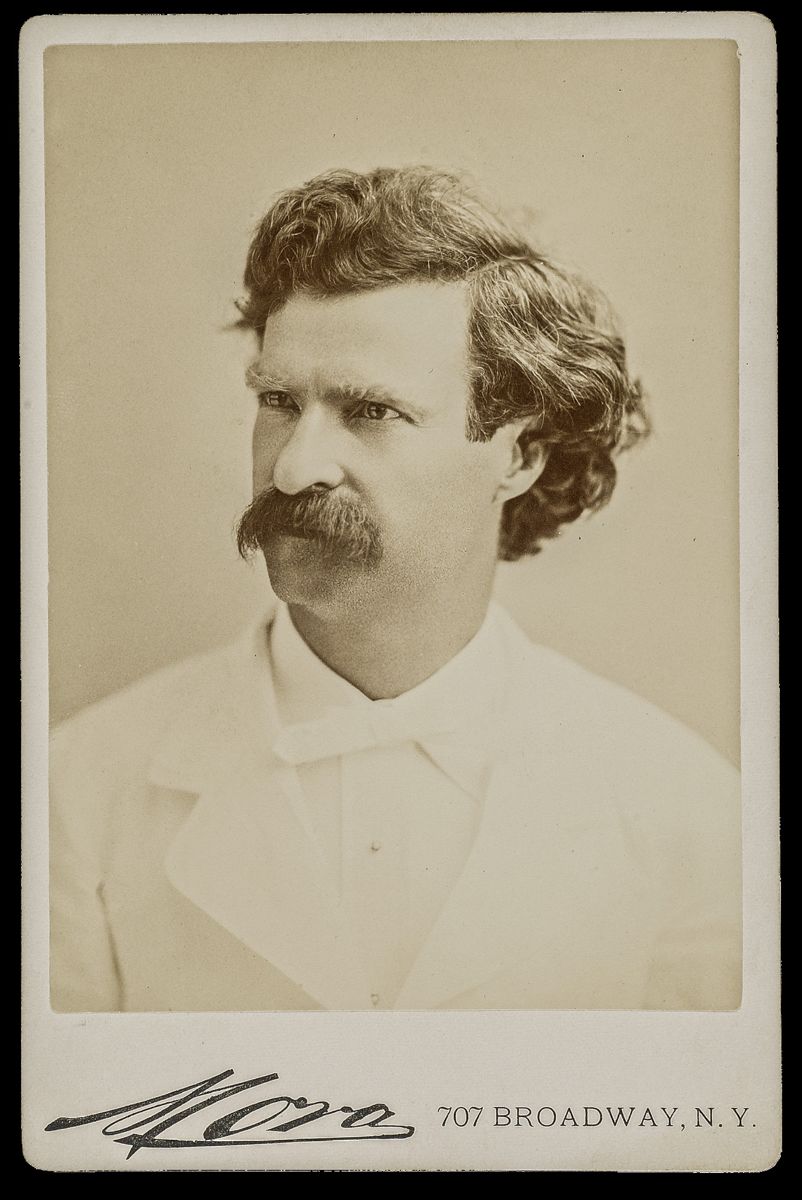
Seldom published cabinet card portrait of Mark Twain, by Mora, Broadway, New York, 1882.
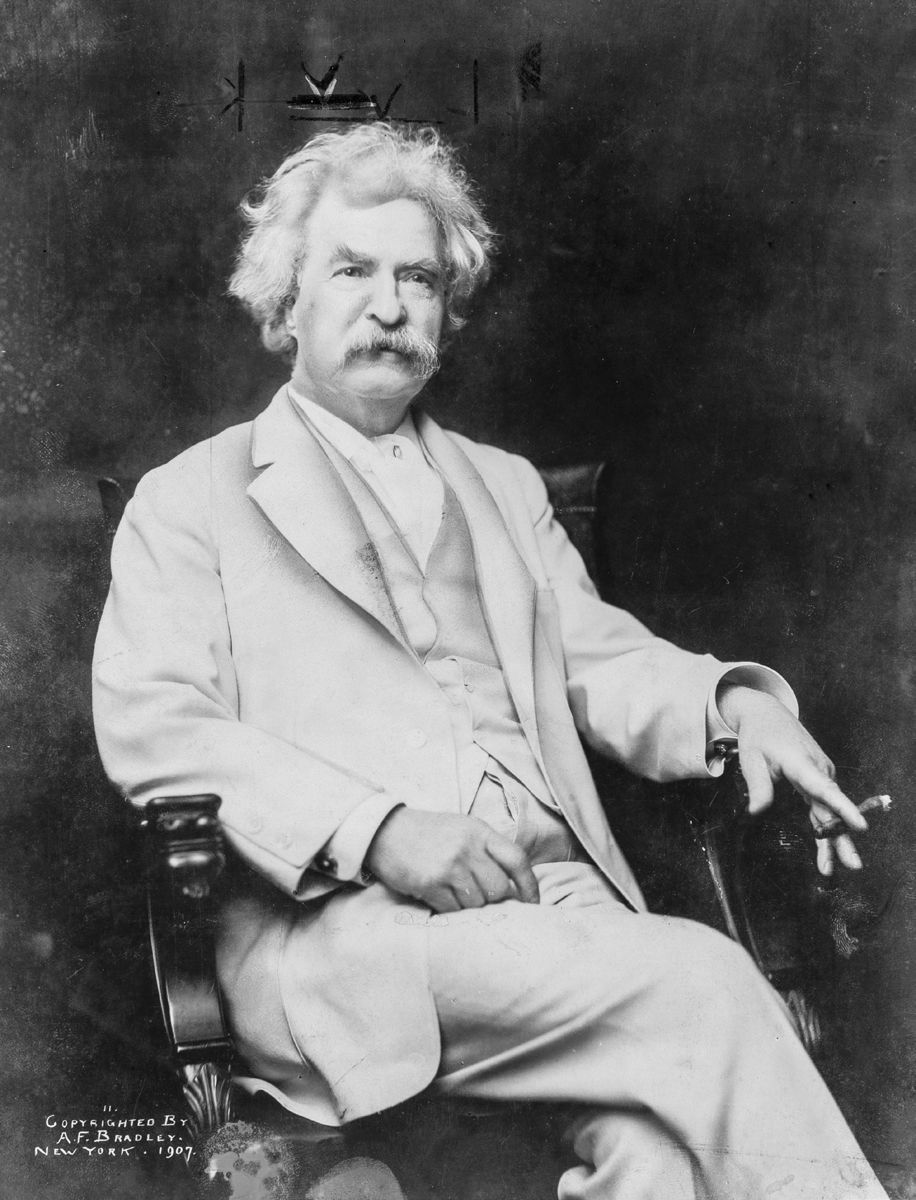
Mark Twain with cigar in hand. A.F. Bradley, New York, 1907. he confines his attention to the experiences of riverboating; he felt a genuine kinship with both men and locale. For instance, Twain takes particular pride in his ability to remember that Island No. 10, “a place so celebrated in the war,” was a mile nearer the Kentucky shore in 1861 when he was a pilot. More important are the associations Twain makes with pilots who fought in the war. More than once the author announces that in his own river days he had served under Horace Bixby and Ed Montgomery, who had led the opposing flotillas at Memphis. In that battle, after his ship had gone down, Confederate Captain Montgomery “swam ashore, fought his way through a squad of soldiers, and made a gallant and narrow escape. He was always a cool man; nothing could disturb his serenity.” It is clear that Twain had found an aristocracy with whom he could associate and share an exalted status. When describing the river aristocracy Twain could even exhibit the same flowery romanticism (as in references to “gallant escape” and “honorable death”) that otherwise he would have scorned. Evidently Twain would have liked to have been one of these romantic heroes himself. In his notebook he recorded a short tale about how some wily Confederates, Jeff Thompson’s “Swamp Rats,” outwitted the enemy at Island No. 8. The importance of the story is the unconscious slip Twain made in writing it: when he referred to Thompson’s men he wrote “we,” then had to strike it for “rebels.” Try as he might, though, Twain could not share in the heroism of the river war. The pilots and soldiers were long gone; even the places themselves had changed. The only permanent vestige of the conflict that remained with which Twain might associate was the war cemetery. With these graveyards the author seemed to be enthralled, for his notebooks are dotted with references to them. Twain included in Life the inscription over the gateway of the Vicksburg National Cemetery. Privately he carried his tribute further, as when he transcribed in his notebook Theodore O’Hara’s famous eulogy: “On fame’s eternal camping ground/Their silent tents are spread/And glory guards with solemn round/The bivouac of the dead.” Twain’s reverence for the war dead may be viewed in a sense as atonement for his own shirking of duty. Though he never served his country—either of them— he paid honor to those who did. Yet Civil War graveyards were manifestly the least satisfying of all of Twain’s associations with the war. Throughout Life on the Mississippi the author searched vainly for a war experience, even an ersatz one, in which he might attain status as a hero and thus efface his memory of skulking. Twain failed, of course, and had to cope with his guilt through defense mechanisms. One such mechanism involved a way of perceiving the war as a whole. Having failed to deflate it, having failed to experience or even to associate meaningfully with it, Twain transformed the image of war so that it ceased to be a thing of awe and reverence, but became one of loathing. …which brings us to Fort Pillow. Forty miles above Memphis Twain passed the place where Bedford Forrest’s Confederates had butchered, some say deliberately massacred, a garrison of black Federals and white Tennessee Unionists. The author’s reaction to the incident is severe: “Massacres are sprinkled with some frequency through the histories of several Christian nations, but this is almost the only one that can be found in American history; perhaps it is the only one which rises to a size correspondent to that huge and somber title. We have the ‘Boston Massacre,’ where two or three people were killed; but we must bunch Anglo-Saxon history together to find the fellow to the Fort Pillow tragedy; and doubtless even then we must travel back to the days and the performances of Coeur de Lion, that fine ‘hero,’ before we accomplish it.” This passage is significant in several ways. It underlines a theme of Huckleberry Finn, Twain’s distinction between the romance of the river and the violence along its banks. As such, the Fort Pillow massacre takes its place with the shooting of Boggs and the GrangerfordShepherdson feud. Moreover, the passage corresponds to an incident that Twain would relate two years after publishing Life. “In “Private History,” the author tells of how the Marion Rangers’ first foray against the foe resulted in the death of a mysterious stranger, presumably an innocent civilian. The tragedy may never have occurred, but its narration allows Twain in a way to characterize the whole war as one big massacre, a lot of senseless killing. In the end, this is the image of war which Twain found most satisfying, for fleeing from senseless violence, the murder of the mysterious stranger, the massacre at Fort Pillow, provided the best possible justification for his desertion. During his Southern foray, Twain was sometimes confronted with storied Confederate generals, of whom there were quite a few in postbellum New Orleans. In such encounters, Twain’s sense of inferiority led him to reduce their stature through one of his favorite devices, comic deflation. At the Washington Artillery Armory in New Orleans, Twain had the opportunity to view E. B. D. Fabrino Julio’s famous equestrian portrait, The Last Meeting of Lee and Jackson. When referring to it in Life on the Mississippi, he sought to deflate the overblown aura of sanctity surrounding the two Confederate heroes by giving Julio’s painting alternative titles: “First Interview between Lee and Jackson”; “Last Interview between Lee and Jackson”; “Jackson Introducing himself to Lee”; “Jackson Accepting Lee’s Invitation to Dinner”; “Jackson Declining Lee’s Invitation to Dinner—with Thanks”; “Jackson Apologizing for a Heavy Defeat”; “Jackson Reporting a Great Victory”; “Jackson Asking Lee for a Match.” Reminds us that even when addressing America’s Civil War, Mark Twain could still be a funny guy. 1.
Notes

Thomas Daniel Young, Floyd C. Watkins and Richard Croom Beatty, eds., The Literature of the South (Glenview IL: Scott, Foresman, 1968 [1952]), 100. Arlin Turner, “Samuel Langhorne Clemens [Mark Twain]” in Robert Bain, Joseph M. Flora and Louis D. Rubin,
Jr., eds, Southern Writers: A Biographical Dictionary (Baton Rouge: Louisiana State University Press, 1979), 85-86. Arthur G. Pettit, Mark Twain and the South (Lexington: University Press of Kentucky, 1974), 13-14, 18, 20, 24. Pettit, Twain and the South, 25-27. Ibid., 28, 194 n.17. Frederick Anderson, Lin Salamo and Brenard L. Stein, eds., Mark Twain’s Notebooks and Journals (Berkeley, 1975), vol. 2, 43637. Subsequent references to Notebooks will appear in my text. Steve Davis, “Mark Twain, the War, and Life on the Mississippi,” Southern Studies: An Interdisciplinary Journal of the South, vol. 18, no. 2 (Summer 1979), 232. This article for Civil War News draws on my essay from way back.
Stephen Davis earned his Ph.D. in American Studies from Emory University back in ‘79. Since then he’s been writing articles and books on “de waw.” His next title, The Atlanta Daily Intelligencer Covers the Civil War, is now released by the University of Tennessee Press.