
1863–1864 Saw Russian Squadrons and Fancy Balls in America
By Ivan Agyeyev and Yuriy Kirpichoff · Originally published September 2022 · pp. 42–43
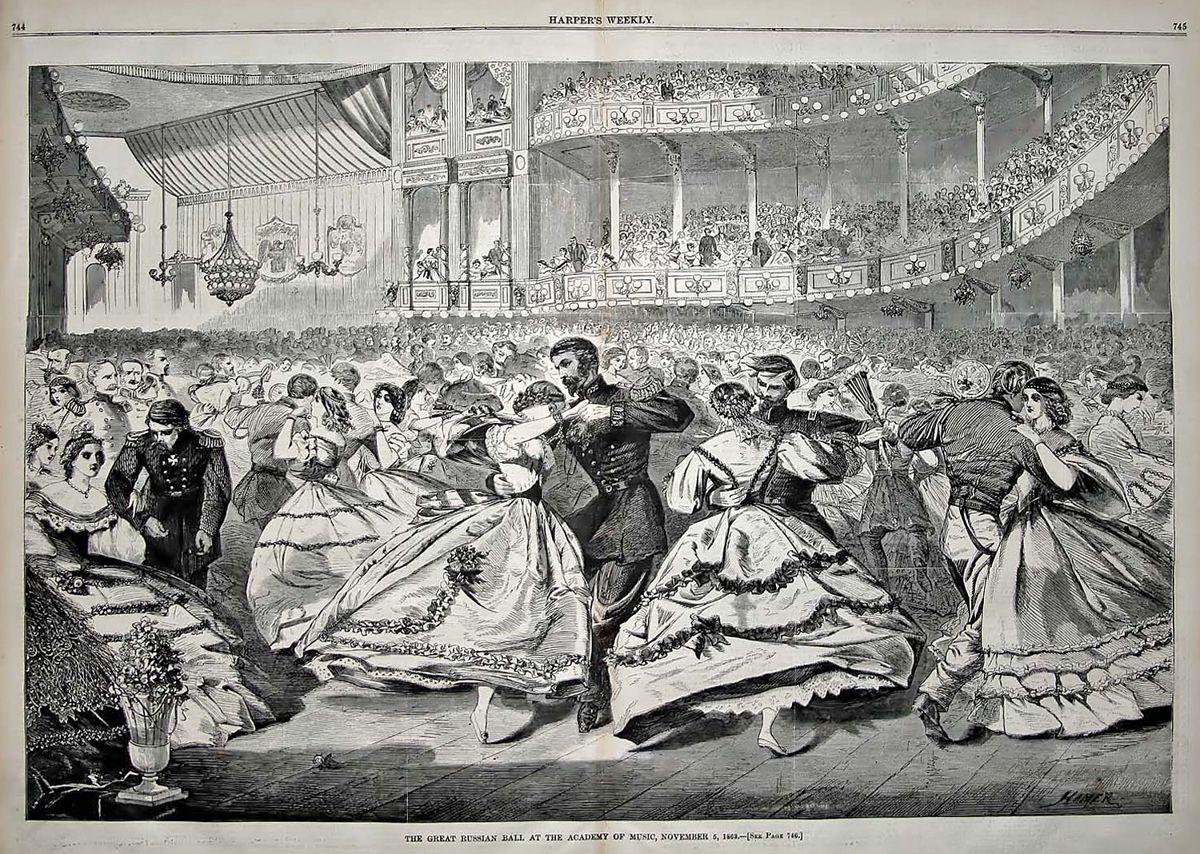
1863–1864 Saw Russian Squadrons and Fancy Balls in America by Ivan Agyeyev and Yuriy Kirpichoff The American Civil War broke out 160 years ago. The Russians were involved, either directly or indirectly… The ball thundered! It was gorgeous and opulent. Even though it didn’t measure up to some previous balls in New York, it was celebrating the Prince of Wales’s visit. Beautiful American women were waltzed around by valiant Russian officers, surrounded by countless men and women, a large orchestra, and tables with fine cuisine. Yes, the ball was noteworthy, and a few of the dishes would live on in culinary annals. More than a hundred different varieties of delectable food treats, including oysters, truffles, pheasants, goose liver, and pigeon cutlets. The following dishes were created especially for this ball: “Snitmitch a la Russe,” “Siberienne and New Yorkaises charlottes,” “d’antzick Orientales jelly,” and “Pains d’abricots a la Beresina.” Numerous glazing options include “Pierre le Grand,” “Washington,” “Alexander II,” “Lincoln,” “L’ermitage Russe,” and “L’aigle Americain.” Additionally, there was “Nesselrode pudding” and a unique “Bombes spongade.” The banquet used 3,500 bottles of wine in addition to 12,000 oysters, 10,000 fowl, 2,000 pickled cucumbers, etc. The Nesselrode pudding, and several other Russian references, indicate an awareness of Russian things. Karl Nesselrode was not only the Russian Empire’s Chancellor and Minister of Foreign Affairs, he was also an expert food critic. His personal chef, Mui, came up with the idea and gave the dish its name, a frozen dessert or sauce made from mashed chestnuts. The June 25, 1863, authorization by Emperor Alexander II to send two cruising squadrons to both coasts of the United States was the catalyst for the celebration. A squadron led by Rear Admiral S.S. Lesovsky, consisting of three frigates, two corvettes, and a clipper, traversed the Atlantic Ocean. The Oslyabya, another frigate, arrived in New York from the Mediterranean. Three corvettes and two clippers made up the squadron visiting San Francisco under the direction of Rear Admiral A.A. Popov.
Expeditious goals Russian sources claim that, during the Civil War, Russia came dangerously close to saving the North, and that the tsar-liberator, who outlawed slavery, dispatched squadrons to fight for them out of great affection. However, this is untrue. Furthermore, it’s probable that the United States saved Russia from a new conflict with the most powerful European nations as well as from a fresh humiliation. Simply put, Russia was dealing with its own issues. On January 22, 1863, an uprising started in Warsaw and quickly spread throughout all Poland. Russian forces started putting down the rebellion, but in April 1863, England, France, and then Austria, issued angry communications to the Russian government; a serious possibility of war with a coalition of the most powerful Western powers loomed. Because the Baltic fleet would have been stuck in the Gulf of Finland, just like during the Crimean War, if war broke out; the government planned in advance to send a portion to sea to threaten England with a cruiser war. But where should the flotilla be exposed? Although Russia abolished slavery on February 19, 1861, less than two months before the American Civil War started, there was not enough time for a change in societal attitudes. The majority of the Russian fleet’s officers and commanders were descended from landowner families or from slave owners. The decision was made to visit the northern states because hostile England and France supported the South and because northern ships blocked the southeastern coast. The tsar did not even consider aiding the Northerners before Russia’s internal rebellion began and the Anglo-French threats followed. Russian ships, particularly swift multi-gun frigates, were definitely capable of damaging English commerce vessels, but ocean warfare required an operating base. It could only be obtained from the northern U.S. states. They swiftly came to an agreement with President Lincoln because the presence of friendly naval forces was in both their best interests. The efforts of Captain 1st Rank Stepan Stepanovich Lesovsky, the Russian naval attaché in the United States, also helped in this regard. He was given the rank of Rear Admiral was made commander of the Atlantic squadron. The mission of the expedition was to “act with all possible and available means against our enemies, inflicting the most sensitive damage and damage to enemy trade by means of individual cruisers or making attacks by the whole squadron on the weak and unprotected places of the enemy colonies in the event of a war with the Western powers now anticipated.” The squadron was required to wait in America for the outcome of talks with the European countries and only start cruising in the event of a “unfavorable decision.” Every ship was given a designated cruise region. The flagship frigate Alexander Nevsky was assigned to patrol along “the path of British ships heading from Liverpool to Nassau with various military supplies for the South American states; frigate Peresvet on the route of ships from England to the East Indies; corvette Varyag on the route of ships from England to South America; and corvette Vityaz on the route of East Indies ships traveling from the Cape of Good Hope to the island St. Elena.” The frigate Oslyabya was given the territory of the Azores; the clipper Almaz was given a zone in the central Atlantic just north of the equator. The arrival of the Russian squadron caused quite a stir. The American newspapers, New York Times, New York Herald, New York Daily Tribune, Daily Alta California, Harper’s Weekly, National Intelligencer, etc. published a ton of articles, illustrations, and announcements about parades, displays, receptions, and dinners in honor of Russian sailors in the fall of 1863. Harper’s Weekly created a large number of top-notch graphics and in-depth essays. Many Americans were aware of the true significance of the Russian fleet’s appearance: “There is one moment in the Russian fleet’s arrival here that should not be disregarded. All Russian ships were halted at various ports throughout the Crimean War. If Russia now finds itself at war with the nations who made such a fuss about Poland, her fleet will be free and have the chance to pursue the enemy’s commerce shipping (New York Herald, October 7, 1863). The 45-gun frigate Oslyabya was the first to anchor in New York Harbor, on September 11, 1863. The frigates Alexander Nevsky (50 guns) and Peresvet (43 guns) arrived two weeks later, on September 25. The corvettes Vityaz (17 guns) and Varyag (17 guns) arrived the following day. The Almaz clipper (5 or 7 guns), which had been waiting for nearly two weeks due to a calm, finally showed up on September 29. Captain P. Zelenoy did not want to take a chance by using up his tiny allocation of coal. Not all of it went perfectly. It was not simple to cross the ocean. Shortage of experience on lengthy voyages caused sailors to suffer from overwork, wet, windy weather, and a lack of fresh supplies. Many people became ill, and some died. Luckily, a private hospital for the care of sick emigrants in New York assigned two wings to the Russian sailors; 87 individuals were sent “from the frigates Alexander Nevsky,” Peresvet, 68, and from the corvette Vityaz,” 5; 115 were down with scurvy. The majority of the sailors recovered quickly because of the clean air and fresh food. The emphasis of the Secretary of State W. Seward and Secretary of the Navy G. Welles was focused on the Russian seamen. The wives of the American president and the leaders of the U.S. Congress, as well as senators, representatives, and members of the House of Representatives and their families (a total of more than 500 persons), paid visits to the ships. The Russian sailors’ escape from the Baltic became a significant issue once they arrived in America. Thirty sailors deserted by November 3, 1863, “of whom 7 Chukhons, 9 Poles, 9 Russians, and 5 were converted from Jews.” It is understandable why Jews fled the Russian Empire; even after changing their religion, life there was not pleasant. The Poles’ decision was easy to make because Russian troops were currently occupying their country. Lesovsky defended himself by saying that some of the fugitives escaped despite having spouses and children at home, “in whom
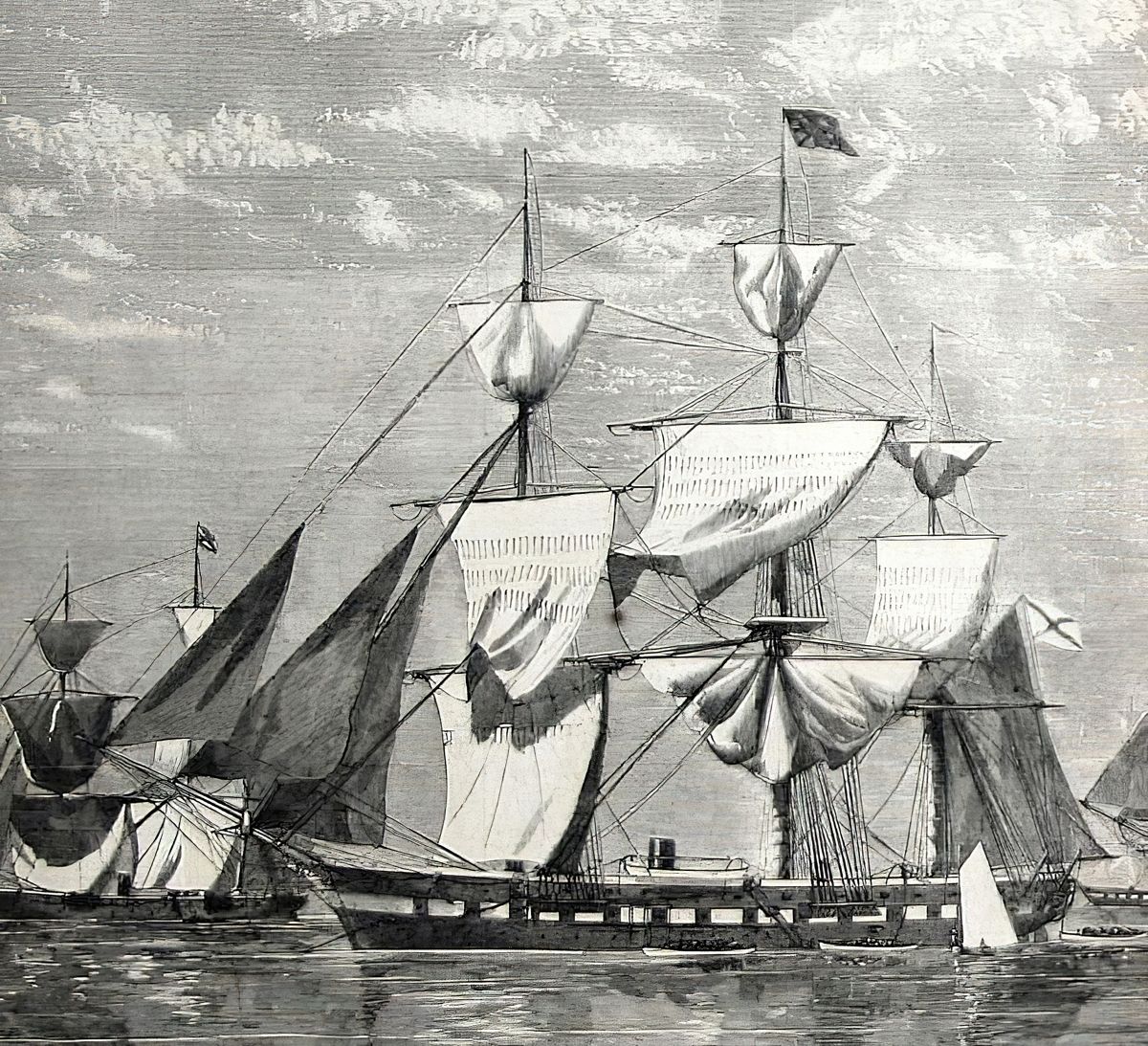
The Alexander Nevsky in New York Harbor, 1863. Detail from an illustration in Harper’s Weekly. one could least of all anticipate a purpose to flee.” The admiral made an effort to provide an explanation for the desertions by pointing to the temptation offered by U.S. Army recruiters. “300 dollars, which at the present time are given per person when recruiting [a large number of] people in the army and which make on the coast speculators of the lowest hand resort to possible tricks, soldering, etc. to seduce sailors from their duty,” he said. It may have been more about their longing for freedom than it was about money. If some enlisted in the military, it was because doing so was the quickest path to acclimating in a foreign land. Lesovsky was forced to stop sending crews ashore to thwart additional escapes, following the lead of the French and British, whose ships were also stationed in the harbor. However, despite the steps adopted, including the requests of the Consul General in New York, Baron P. Austen-Saken, to the American authorities, the desertions did not stop, and it proved to be incredibly difficult to get their men back. Some 87 sailors left the squadron while it was in the United States; many of them joined the Union Army. Despite the Russians’ passionate encounter in America, the marriage ended up being one of convenience because of the way things played out, and they also feared an overreaction in St. Petersburg. The head of the Russian foreign policy department, Alexander II, Gorchakov, acknowledged that no proposal for an alliance had been made by the Americans by September 23, 1863, although not all Russian ships had yet arrived in New York. The minister added, “We would, however, reject it as meaningless. Our political objectives and traditions overlap, thus the treaty already exists in practice.”
American rapture and cooling Soon, the Americans’ extraordinarily cordial reception of the Russian sailors warmed even Gorchakov’s heart. In St. Petersburg, the warm welcome given the Russians had a lasting impact. The Russian fleet’s successful tour to the United States was most especially celebrated in the navy ministry. Admiral N. Krabbe, Russia’s navy minister and fleet reformer, wrote Lesovsky, “The dazzling and solemn reception given to you in New York inexpressibly pleases me and all the friends of the fleet… Everyone is talking about you, dear Stepan Stepanovich, and you are the true lion of the moment.” Even here, things didn’t go perfectly. Lesovsky complained about the aggressive materials to the New York Herald, regardless of how kind the Russian officers were or how the ladies circled at the balls: “The wife of the editor of this newspaper, an arrogant and quarrelsome woman, was on my frigate and complained to her husband, that she was insulted… There is not a shred of justice in this at all. I was informed of her arrival, personally welcomed her, drove her about the frigate, treated her with the same courtesy as many other women who visited the frigate, and introduced her to our embassy’s secretaries, Messrs. Bodisko and Davydov, as well as our consul general, Baron Osten-Saken.” The New York Herald lashed out, saying “After the Russian navy arrived, Russian frenzy seized us. We discussed speeches and banquets and even compared Alexander to Abraham Lincoln. We doubt Russia would send its navy here if it needed to aid us in our fight against England, but it did so to keep it safe in case of a war with France. Her fleet was not worthwhile to dispatch. With all these savages on board, one of our battleships could destroy it in two hours.” The price of democracy is as follows. A free press, which has never existed in Russia, is one of its essential characteristics. The improvement in the northerners’ worldwide stature and the American public’s sympathy for the Polish insurgents, along with a long-existing antipathy for authoritarian regimes, were the underlying causes of the chill, not the disgruntled lady’s fury. Smart N. Krabbe suggested to Lesovsky that he “take a trip through other American ports” since he anticipated the transition from elation to satiety. President Lincoln agreed with this viewpoint. The squadron did not leave New York until November 15, but eventually set sail and arrived in Washington on December 3 with the Oslyabya frigate, joined by the Vityaz, Varyag, and Almaz corvettes. Russian ships docked in Alexandria, across the Potomac from Washington. On December 5, Secretary of State William Seward introduced the sailors to the Cabinet in the capital. Two days later, the secretary of state and other cabinet members attended a supper with the Russian consul after Seward hosted a banquet for the admiral and the ship commanders. On December 9, Lesovsky attended a reception at the Navy Ministry with the ship commanders and diplomatic personnel from Washington. On December 12, “500 people: senators, representatives of the House of Representatives and their families” were welcomed on board the flagship frigate in a particularly lavish ceremony. Schuyler Colfax, the Speaker of the House of Representatives, spoke on behalf of the visitors. President Lincoln asked Lesovsky to delay his departure while he recovered from chicken pox. He stated that while he would be receiving the sailors at his home, he was unable to board the ship. The admiral and ship commanders were introduced to the President and Mrs. Lincoln at a formal reception attended by members of Congress, top government officials, and members of the diplomatic corps. The President attributed the military inability of Britain and France to intervene in the Civil War between the North and the South to the presence of Russian squadrons off the American coast. In order to persuade London and Paris that Russia was a prospective ally of the United States, Lincoln and Seward were interested in a cordial reception of Russian ships; they were somewhat successful in this endeavor. Napoleon III refused to recognize the Confederacy, and warships the Southerners had built at Liverpool remained in England. The Russian ships left in New York in the spring of 1864 were soon leaving for their homeland.
As a result of Saint Petersburg’s realization that conflict with the Western powers was no longer a possibility, on April 28, Krabbe expressed his strongest desire to return to the commander of the Atlantic Ocean fleet. After some of the squadron were sent to the Far East, Lesovsky traveled to Boston with the remaining ships. A committee of city residents was established to welcome the visitors, and a “special pier meant solely for Russian rowing ships” was constructed in the harbor. On the frigate Oslyabya, a sizable reception was held that May 16. Excursions, a trip to Harvard College, a tour of the navy yard and workshops, a stop at an armaments factory, and other locations, a gala supper and music, as well as a holiday and treats for sailors and lower ranks in Boston Park, were all on the agenda for the visit. “The Russian squadron did not offer us either weapons or military munitions to repress the insurrection,” the mayor of Boston declared at the goodbye banquet, “but it brought with it more than this – a sense of international brotherhood, its spiritual assistance.” By this time, the Polish revolt had been largely suppressed, finally put down in early June, and on July 20, the ships Oslyabya, Peresvet, and Vityaz went to sea. That marked the end of Russian assistance to the North. When the Union launched the Petersburg campaign in July, it was evident that the Confederates would be defeated. The authors don’t believe the Russian squadrons made a significant contribution to the ultimate Union victory. The famous Mahan principle, that a good fleet will carry out its duties and restrain the adversary by virtue of its very existence, was reaffirmed by the Russian squadrons, something that rarely happened to them. Yuriy Kirpichoff is the author of popular publications on naval history on the website of the Russian Navy, in the Russian naval magazine Gangut, The Artilleryman magazine, and in other publications. Ivan Agyeyev is studying history at the University of Northern Florida.