
Are You Hot In Those Clothes?
By Bill Christen
June 2009 Civil War News

Bookmark and Share


Among the most frequently asked spectator questions, “Are you hot in those clothes?” ranks in the top five with “Is that a real fire?” “Is that food edible?” “Are those real guns?” and “Do you actually sleep in those tents?”

To the latter four questions reenactors can easily answer “yes.” However, we do not need to answer in the affirmative to the first, and neither did the citizens and soldiers of the 19th century.

A more appropriate question when thinking about portraying people of the period is, “Did men alter their wardrobe for warm weather during the 1850 to 1875 time period?” The answer is certainly — men (and women) had common sense back then, they just did not have mechanical air conditioning!

Humankind has always needed protection from the weather. Climate influences the type of clothes that people wear. In warm climates, people have come to wear garments made of lightweight fabrics like cotton or linen, which have a fairly open weave.

These materials absorb perspiration and allow air to flow around the body. White or light-colored clothes reflect the sun’s rays. The type of fabric is more significant than the number of layers as evidenced by Bedouins in the desert.

Coping with heat might have been easier than we can comprehend because of differences in and reliance on technology. There was no central heating or air conditioning, so people had to dress accordingly.

The contrast between indoors and outdoors was less as buildings were not airtight, rarely had window screens and suffered from poor insulation. People never knew anything different without the experience of climate-controlled buildings and closed vehicles.

Only natural fibers were available and the concept of exposing great amounts of bare skin in public hardly a polite one.

Not everyone coped well with the heat, particularly if one moved between the climate extremes of a large country like the United States. One example is documented in The Daily (New Orleans) Picayune from 21 November 1855:

‘Ow 'Orrid 'Ot! So exclaims Mr. Fitzflunkey, the newly arrived Johnny Bull, after sweltering for a few hours about the streets, puffing and blowing, continually wiping from his big, round flushed face the streams of perspiration, and no doubt fully appreciating Hamlet's exclamation: “Oh! That this too solid flesh would melt!”

Iced water, iced porter, iced ale, iced 'aff-an-aff can't assuage Fitzflunkey's thirst. He burns; he swelters, he gasps. He prays in vain for relief; his sighs and pantings do not cool the burning air; his oft-recurring reminiscences of the moist, cool, clammy, foggy London atmosphere but serve to increase his torments.

As he waddles along, larding the lean earth, how he envies the small, meager, dried-up, yellow skinned Creole who saunters by, dressed all in loose, white garments, his neat patent leather pumps, his white socks, his light cravat, his little cane, his cigarrito, his Panama-looking hat with the white sack and pants, and irreproachable shirt-front, as cool as the wearer is calm — just as if both wearer and garments had stepped out of a refrigerator kind of a bandbox to take a whiff of air and a gleam of sunshine.

The sight is striking and amusing, and is almost of daily occurrence just now in our streets. The freshly imported Englishman wonders how any civilized being can live in such ‘a dom-d bloody ‘ot climate;’ the Creole takes another whiff at his cigarrito, twirls his moustache and mutters: Quel beau temps!

Those men who did cope followed general principals on warm- weather dress. They chose clothing made from natural fabrics (linen, cotton, hemp and lightweight wool), which helped cool as well as warm.

They wore light cotton or linen drawers, or none at all (some men had not shifted to wearing drawers and still relied on shirts with long tails).

They selected lighter colors (especially natural-colored linen coats, trousers and vests. Some linen was so thin that drawers had to be worn to protect one’s modesty.

Coats were removed politely with permission of any ladies present. Men dispensed with wearing a vest, if possessing a clean, presentable shirt. By the middle of the 19th century shirts were no longer consider underwear and there was no social taboo about shirt sleeves.

I hope, however, that reenactors back in camp after an event’s “battle” will refrain from appearing shirtless when ladies are around. Victorians may have taken offense at too much flesh showing in public. They rolled up shirtsleeves. They wore straw hats.

They used unusual methods such as wearing flannel year round or put leaves or pads in their hats. The later (pads sold to men that could be moistened and placed upon one’s head, or, one period tip that I have field tested, cabbage leaves) was also field tested by soldiers as indicated in an account in Daniel E. Sutherland’s Seasons of War: The Ordeal of a Confederate Community 1861–1865 (New York: The Free Press, 1995).

“…But as nightfall approaches, the advance has sputtered. Temperatures hovered around 90 degrees at midday. Veterans, who had learned a trick or two about campaigning, stuffed leaves in their hats to help ward off the sun.”

Some of the coping mechanisms apply to women as well — the sheer dress and a parasol were excellent “keeping cool” devices.

“Let the dress suit the occasion” was a by-word of men’s etiquette books such as Cecil B. Hartley’s The Gentlemen’s Book of Etiquette, and Manual of Politeness (Boston: G.W. Cottrell, 1860). Hartley advised men to “indulge in light clothes during the warm months of the year, but for the ball or evening party, black and white are [the] only colors admissible.”

He also discussed wearing flannel:
“Flannel, too, has the advantage of being warm in winter and cool in summer, for, being a non-conductor, but a retainer of heat, it protects the body from the sun, and, on the other hand, shields it from the cold … while the flannel is perhaps healthier as absorbing the moisture more rapidly, the linen has the advantage of looking cleaner, and therefore be preferred. As to economy, if the flannel costs less to wash, it also wears out sooner; but … a man’s wardrobe is not complete without half a dozen or so of these shirts….”

The Tennessee Baptist newspaper on 4 May1861 had an item that described how flannel could be worn all year round.

The Wearing Flannel
In our climate fickle in its gleams of sunshine and its balmy airs, as a coquette with her smiles and favors, consumption bears away every year the ornaments of many social circles. The fairest and loveliest are its favorites. An ounce of prevention in this fatal disease is worth many pounds of cure, for when once well seated, it mocks alike medical skill and careful nursing.

If the fair sex could be induced to regard the laws of health, many precious lives might be saved; but pasteboard soles, the low-neck dresses and Lilliputian hats, sow annually the seeds of a fatal harvest.

The suggestion in the following article from the Journal of Health, if followed, might save many with consumptive tendencies from an early grave:

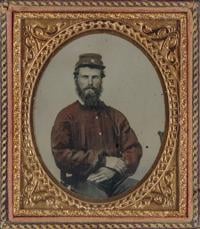
Put it on at once; winter and summer, nothing better can be worn next to the skin than a loose red woolen shirt; “loose,” for it has room to move on the skin, thus causing a titillation, which draws the blood to the surface and keeps it there; and when that is the case no one can take cold; “red,” for white flannel fulls up, mats together, and becomes tight, stiff, heavy and impervious.

Cotton-wool merely absorbs the moisture from the surface, while woolen flannel conveys it from the skin and deposits it in drops on the outside of the shirt, from which the ordinary cotton shirt absorbs it, and by its nearer exposure to the air it is soon dried without injury to the body. Having these properties, red wool flannel is worn by sailors even in the midsummer of the warmest countries. Wear a thinner material in summer.

Being “in uniform” is an important part of military culture, and we would do well to represent that aspect, but during fatigue work and off-duty moments some things can be done to stay cool.

Since vests were not issued, there certainly is no need to wear one. On the march, coat buttons can be undone and coats slung with permission of an officer.

One hot day in 1861 Co. A of the 7th Ohio was detailed to unload supplies freighted up the Kanawha River. Capt. William R. Creighton permitted his men to take off their coats. As they sprawled out to rest, Gen. William Rosecrans rode up without staff members.

Creighton leaped to his feet as Rosecrans asked, “Don’t you know, sir it is against orders to allow men on duty to remove their equipment?”

Creighton replied smartly that “the man that issued that order never did a day’s work, and I’ll see him in hell before I let my men swelter with their accouterments on.”

Rosecrans silently rowed to the boat. “Know who that is?” a soldier asked Creighton. “No, and I don’t care.” “That’s General Rosecrans.”

When Rosecrans returned, the company, in full equipment, gave him a “present.” After Creighton had “put his men through the manual,” Rosecrans raised his hat and said: “A company that can handle muskets that well should be allowed to unload a steamer without anything on if they want to.”

Yes, men in the 1860s did alter their wardrobe to suit the temperature. They still got hot, sweated and were sometimes uncomfortable. And, if necessary, found ways to really cool off.