
Portraits of Conflict: A Photographic History of Tennessee in the Civil War

By Richard B. McCaslin
Illustrated, appendix, notes, bibliography, index, 398 pp., 2007. The University of Arkansas Press, 201 Ozark Ave., Fayetteville, AR 72701, $59.95 plus shipping.

Reviewer: Michael J. Winey
Michael J. Winey, who has a BS in history and MS in his­tory mu­seum train­ing, was a curator for more than 25 years and is retired from the U.S. Army Military His­tory Insti­tute in Carlisle, Pa.


Review:
After a hiatus of nine years another volume in the Portraits of Conflict series has been produced and the wait is well worth it.

The author and editors, in cooperation with the University of Arkansas Press, have presented a history of Tennessee in the Civil War, along with an outstanding number of great portraits of men and women involved in the war in Tennessee.

Along with a well-written general text presenting a series of events of four years of Tennessee’s participation/occupation is an extremely valuable first chapter discussing the photographers from Tennessee or those who plied their trade in Tennessee who produced many of the images.

That first chapter alone is a significant contribution to the scholarship on a still very sketchy look at a huge number of image makers who plied their art form throughout the United States during that “late unpleasantness.”

Although the greatest number of photographers were in the city of Memphis, the other major cities of Tennessee (East, Central and West) had their fair share and many of the smaller towns accommodated one or more image makers. One of the best known of all was a young man from Ohio who opened a small gallery on the heights overlooking Chattanooga on Lookout Mountain.

Following Gen. Braxton Bragg’s evacuation of the Chattanooga encirclement and siege, Robert M. Linn made countless images of not only the scenery from the heights but of thousands of soldiers individually, in pairs, groups and units — from the common soldier to the conqueror of the mountain. Included are Maj. Gen. Joseph Hooker, and the commander of the Western Armies, Maj. Gen. Ulysses S. Grant. Most were photographed from a prominent rock formation on the summit.

Each chapter follows the war chronologically for the Western Armies including Shiloh, Murfreesboro, Chickamauga, Chattanooga, Franklin and Bentonville. A chapter covers those Tennessee units that fought in the Eastern Theater, viz. Virginia, Gettysburg, the 1864 Overland Campaign, Petersburg and the final early days of April where only 480 men of Tennessee C.S.A. units laid down their arms at Appomattox Court House.

McCaslin notes that “the highest ranking Tennessean in the Army of Northern Virginia, Maj. Gen. Cadmus M. Wilcox, wearing borrowed clothes and leading the fragments of his division” participated in the surrender ceremony.

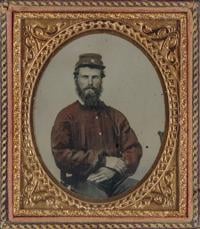
Why this volume is titled Portraits In Conflict is amply and very pleasantly borne out through the numerous portraits that follow the text of each chapter. Each photo in some way is apropos with regard to the text. Many images are of common soldiers who are pictured wearing a variety of uniforms that would evoke a study in themselves.

Each portrait has a biographical sketch that follows the soldier from enlistment through the war to his demise or postwar activities. Both Union and Confederate images are presented since Tennessee was a divided state within a divided Union.

Many of the images are from the extensive collection of Civil War photos at the U.S. Army Military History Institute and are “old acquaintances” of mine. Numerous images have not been presented often — some are in this volume for the first time.

A final chapter covers the Reconstruction period and the men who were the players during that turbulent era. Many of those players were participants on one or the other side during the late Civil War.

Numerous, as well, are politicians who had been in that “business” before and during the war and were vying for position within the states and for election to the U.S. House and Senate.

Other subjects were involved in a more nefarious pursuit which was founded in Pulaski, Tenn., as a social club but which quickly became a paramilitary operation to counteract Radical reforms — the Ku Klux Klan. Numerous Tennesseans were participants in that organization and many were ex-Confederate soldiers.

Portraits and biographical sketches of the contenders of that postwar stormy era are expounded with great deft and thoughtfulness. The final chapter is one well worth the reading in its own right.

The extensive appendix is a useful addition to the photo captions. Discussed in greater detail, in alphabetical order, are many of the portraits pictured throughout the volume. Much additional valuable information is given which did not necessarily fit in the context of the chapter where the portrait was used. For the genealogist alone this would be worth the price of the book, as well as it is for the in-depth writer of Civil War history.

As stated at the outset of this review, Portraits of Conflict is a continuation of a quality publication series dealing with (thus far) the Southern Confederacy. The physical book is nicely printed on quality stock paper and the images are sharp, clear and impressive.

This volume, along with the other states heretofore published and those yet to come, will be an asset to the history of the Southern states at war. My only suggestion would have been to include an Order of Battle for the units, both Confederate and Union, as an added appendix.

Portraits of Conflict: A Photographic History of Tennessee in the Civil War is a good read and a delight to anyone who enjoys seeing portraits of the men who served. I highly recommend this volume.