There's a preservation victory that took place in Lynchburg, Va., recently that is worth noting. The most important Civil War feature of Lynchburg was purchased by a local historical society from private hands thus insuring its preservation and interpretation to the public.
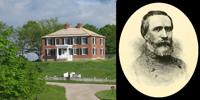
Sandusky is one of the best examples of formal Federal style architecture in Virginia's Piedmont region and a key feature of the June 17-18, 1864, Battle of Lynchburg. The home served as headquarters to Gen. David Hunter and his Army of West Virginia during their offensive against Lynchburg in what has become known as "Hunter's Raid."
The Sandusky home had been in private hands since 1808; fortunately it has had few owners and remains in pristine condition. In 2000 the home was put on the market by the most recent owner, Mrs. Louise Adkinson. Mrs. Adkinson, a widow in her 80s, could no longer keep up with the demands of a historic home. She and her husband had owned Sandusky since 1952 and took excellent care of it.
Mrs. Adkinson's wish was to see the house become a museum so that the public could share its rich history. When two men from New York, who rode down on their motorcycles, were interested in purchasing Sandusky for private use, she carefully sidestepped their advances. This served as a wake-up call; soon several historically minded Lynchburg residents decided that Sandusky was too important to the city and its history. They sprang into action and decided to purchase it with the goal of opening it to the public.
The Historic Sandusky Foundation was quickly formed. The initial board of directors included a lawyer, a graphic artist, a museum professional, a CPA, an architectural historian and several doctors. Mrs. Adkinson facilitated the sale by reducing the selling price by one-third. Six board members signed their name to the mortgage note and hereafter became known as the "Sandusky Six." Historians James I. Robertson Jr., Carrington Williams and Ed Bearss volunteered their expertise as advisors to the project.
Research on the house began in earnest. Sandusky was built in 1808 by Charles Johnston, an uncle of Confederate Gene. Joseph E. Johnston. The name Sandusky derives from a narrow escape experienced by Charles. As a young man, while on a survey expedition into the Ohio territory, Charles was captured by Shawnee Indianss and held captive for several months; some of his group was killed outright. A Frenchman bought his freedom with "100 silver broaches."
Johnston eventually moved from Prince Edward County to Campbell County, Virginia, and built Sandusky, naming it for the place in Ohio where he was held captive. From Sandusky Johnston engaged in real estate speculation and tobacco trade. He was an occasional business associate of neighbor Thomas Jefferson; Jefferson ate dinner on at least one instance at Sandusky.
After 10 years the home was sold to John Mathews Otey. The Oteys owned Sandusky until 1841. The Oteys are a noted Lynchburg family. John Otey died at the start of the Civil War; however, his wife Lucy became Lynchburg's Florence Nightingale. Appalled at the conditions of the Lynchburg soldiers' hospitals she approached President Jefferson Davis and obtained permission to start her own hospital in Lynchburg.
Hospitals in Lynchburg were the domain of male surgeons and stewards. Otey organized 500 of Lynchburg's leading ladies into the Ladies Relief Society and opened a hospital on Main Street. Their care of wounded and sick Confederate soldiers was superlative; they earned a reputation of having a high recovery rate such that military doctors began sending their worst cases to Otey's hospital.
During the war Lucy Otey lost three of her seven sons and her only son-in-law. She passed away only a year after the end of the war. Some said she was broken by the toll of the war.
In 1841 Sandusky was sold to a career army officer named George Christian Hutter. It remained in the Hutter family until 1952. When Virginia seceded from the Union Hutter tendered his resignation. He then served for a few weeks as Paymaster of the Virginia State Forces when Jefferson Davis asked Hutter to serve as Paymaster for the Confederacy, which Hutter declined citing failing health.
Hutter's three sons served in the Confederate army. The youngest, James Risque Hutter, led the 11th Virginia Infantry to the stone wall on Cemetery Ridge during Pickett's Charge where he was wounded and captured. The Hutter family today remains one of the prominent Lynchburg families and they have been invaluable in piecing together the history of Sandusky during the Hutter era (1841-1952).
During Hunter's Raid, after sacking Staunton and Lexington, and burning numerous homes along the way, General Hunter and his army approached Lynchburg with orders to seize this important city. Lynchburg was a vital transportation center. Situated west of Richmond by 100 miles, three railroads, the Kanawha Canal and the James River all passed through Lynchburg and were crucial links to Gen. Robert E. Lee's army entrenched at Petersburg. The food and supplies that passed through Lynchburg kept Lee's army alive.
When Hunter arrived at Lynchburg he took his command of Sandusky and seized it for his headquarters, letting his army's horses feed on Hutter's corn fields. From all accounts Hunter knew Hutter from their previous army service and allowed Hutter, his wife Harriet and daughter Ada to remain at their home. The location of Sandusky was ideal for use as a control point for an easterly attack upon the city. From the roof of Sandusky signal officers could note the progress of the battle for miles and relay signals when needed.
Union Gen. Charles Halpine noted Hutter's daughter, Ada, and quoted her later in his book Baked Meats of the Funeral. Seventeen-year-old Ada told Halpine:"Oh how I pray for peace, do not misunderstand me however, do not think I crave, or would accept that peace you talk about "" the peace of subjugation; for I am Southern in every fibre. Oh, we have given up everything for the cause, save the barest necessaries of life; and I cannot believe that God would allow a people to suffer so much as we have done, if not intending to reward us with final victory."
After two days of battle Hunter grew more timid, ammunition and rations were running out. From the Sandusky parlor a council of war was held and the decision made to retreat. On their way out they sacked Sandusky, plundered the valuables and slashed the family paintings. The retreating Federal army was pursued by Jubal Early thus beginning Early's 1864 Shenandoah Valley Campaign which saw him advance to the doorstep of the Northern capital "" Washington, D.C.
The Sandusky house was originally the centerpiece of a 1,200-acre estate. Today the historic site encompasses four acres. It is fortunate that the house was owned by so few families. It remains in an excellent state of preservation; little alteration has been made to the structure. This makes the work of restoration specialists and architectural historians much easier.
Fortunately there are numerous surviving letters, diaries and records which document the social history of Sandusky. Descriptions of house repairs, horticultural endeavors, and family life will aid researchers in reconstructing the history of the house and grounds.
The goal of the Historic Sandusky Foundation is to preserve Sandusky and interpret it as it appeared in June of 1864. To learn more visit www.historicsandusky.org
Gregory H. Starbuck has been involved in the study of the Civil War for the past 31 years. He is a museum professional having served as Director of Education for the National Civil War Naval Museum and Site Manager of Old Fort Jackson, Savannah, Ga. In 2000 he was designated Curator Emeritus of the Coastal Heritage Society. He is Executive Director of the Historic Sandusky Foundation.