On July 13, 1991, Monocacy National Battlefield, near Frederick, Md., opened to the public. Fifty-seven years after its legislative creation, the National Park was "born." During the dedication ceremony, former Interior Secretary Manuel Lujan Jr. proudly announced, "this battlefield will now be properly protected as a cherished legacy."
Music filled the air, a Union honor guard presented the colors while Confederate re-enactors offered a rifle salute in remembrance of those who fought and died on the battlefield. A bystander remarked, "You could feel the soldiers' presence during that moment. They would have been proud that we remembered them."
Hundreds of people came that first weekend, eager to see their National Park and to hear more about the "little battle that saved Washington" in the summer of 1864. What they found was a small visitor contact station with six borrowed artifacts, located in the lower level of the rehabilitated Gambrill Mill, a park ranger and one volunteer to greet them. Outside there were public roads that connected several farms, some federally owned and some privately owned, with no signage describing any battle action.
Many of the older Civil War parks have had the luxury of relying on the veterans who fought there to establish the foundation for visitor use and interpretation. In many instances, modern tour roads replace early carriage paths. Wayside exhibits stand next to War Department tablets describing specific troop movements. These foundations were laid by a previous generation.
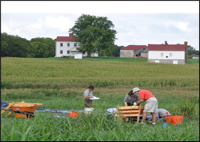
Monocacy was completely different. This battlefield was a blank slate. Fortunately the five farms that comprised the core area where the battle had occurred were still present and being farmed. Unfortunately I-270, a major commuter artery to metropolitan Washington, now bisected the cultural landscape.
Monocacy was a rich resource with a story that had been lost to history. It was full of potential and challenges. Time and resources would prove to be essential factors in affecting progress over the 13 years that passed since the park's opening; however, vision and inspiration were just as important.
In the beginning, it was difficult to know where to start. Projects were easier to justify because we needed everything. There were crumbling structures from years of abandonment or abuse. Although federally owned acreage within the legislative boundaries had been minimal, there had been no money for maintenance and the land had been leased, but not the buildings. Assessments were made and, over the past 13 years, most of our historic structures have undergone varying degrees of stabilization or rehabilitation work to protect them from being lost.
We had a story to tell, but no means by which to tell it. We needed a way to help people find the battlefield and know what happened and where. They needed to know why it was important and how it fit into the rest of "The Civil War" story. We had no park files for reference and no staff to do research. The only book-length accounts ever written specifically on the Battle of Monocacy consisted of one volume, Fighting for Time, written by Glenn Worthington and published in 1932.
Until staffing levels expanded allowing us to spare a ranger to conduct research and still maintain the contact station for visitors, Worthington's book became our "bible." It provided information and inspiration.
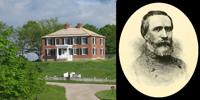
Glenn Worthington was more than an author who had carefully researched the Battle of Monocacy. He had witnessed the battle as a six-year-old child. It made such an impression upon him, that he vowed not to let it be forgotten. When the histories of the Civil War were written in the late 19th and early 20th century, Worthington was appalled that the story of the delaying action fought along the Monocacy River that cost Jubal Early his opportunity to attack the United States capital was being "watered down" or deleted altogether.
Realizing the significance of this battle in the broader context of the Civil War, and the political scenario of the 1864 election when President Abraham Lincoln was losing popularity to the Peace Democrat George McClellan, Worthington decided to write a book so that others might know what happened here.
Glenn Worthington, the adult, had earned a prominent reputation as educator and judge. He formed the Monocacy Battlefield Commission, along with other Fredericktonians, who petitioned Congress to authorize the Monocacy National Military Park in 1928. The bill passed the following year. What a difference one individual can make! He is truly an inspiration.
As we gathered information about our farmsteads and structures, we unearthed incredible stories, such as that of 17-year-old Victoire Vincendiere and her family who fled St. Domingue in the late 18th century and came to the United States. The unmarried French Catholic woman held 90 people enslaved in an area dominated by Protestants of mostly German descent.
Archaeological evidence of the slave village provides fascinating stories not directly related to the July 9, 1864, Civil War encounter, but lends context to understanding the complexity of the border state Maryland and causative issues that are relative.
Periodic flooding has been an issue with our current visitor contact station. In January of 1996, the lower level of Gambrill Mill was evacuated, as 43 inches of floodwater caused thousands of dollars worth of damage. Five months later, advanced warning permitted evacuation before the intrusion of 32 inches of water. Again in December of 2003, an evacuated visitor center was cleaned after a foot of water receded. Numerous other evacuations have resulted in false alarm.
Currently we are delighted to be planning a new visitor center that will be constructed outside the flood plain. Construction is scheduled to begin in 2005. This 7,585-square-foot interpretive facility will feature over 3,100 square feet of exhibits designed to convey the story of the Battle of Monocacy as an event within the Civil War that was a significant period in American history. Information can be gathered from a Union, Confederate or civilian perspective.
Exhibit designers have found innovative ways to display artifacts in combination with other interpretive media to evoke a meaningful exhibition for a variety of audiences. Our goal is to make this an exhibit that not only answers the what, when, where, and why, but so what? A museum shop, offices and park library will also be located in the new facility.
Another exciting project that is currently entering final phases is the park's General Management Plan (GMP). By fall, we should have a preferred alternative to this master plan that will help us in determining the future of Monocacy National Battlefield for the next 15-20 years.
This particular plan is crucial for this park because is establishes the foundation for visitor circulation patterns, uses of existing structures, land use, etc. Skeletal framework such as a GMP is necessary to begin planning trails, wayside exhibits, personal services versus static exhibits, landscape preservation or restoration, archaeology, rehabilitation versus restoration of structures, etc.
Monocacy National Battlefield has progressed a great deal in 13 years, but there is work yet to do. Glenn Worthington made significant contributions in honoring our fallen heroes. Now we must all work together to continue to protect this park as a cherished legacy for future generations.
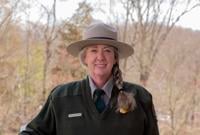
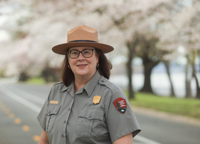
Cathy Beeler has been Chief of Resource Education and Visitor Services at Monocacy National Battlefield since the park opened in 1991. She previously worked at Antietam National Battlefield and was a seasonal park ranger at C & O Canal National Historical Park. She is a Servicewide historic weapons instructor, regional inspector and serves on a national advisory team to ensure safety in use of historic weapons in interpretive programs. She is a graduate of Shepherd College with a degree in elementary education