
Civil War News
For People With An Active Interest in the Civil War Today

Home / Calendar / News Stories / News Archive / Preservation Columns / Book Reviews /
Living History
/ News Briefs / Subscriptions / Testimonials / Artillery Safety Rules
Photo Galleries / Feedback / Links


Preserving Kennesaw

By Willie Ray Johnson


December 2003

In the spring of 1864 U.S. Grant, recently promoted to the newly created rank of Lt. General and assigned to the position of commander of all United States army forces, ordered a concerted offensive by all Union armies.

In the West he ordered Maj. Gen. William T. Sherman to push deeper into Georgia, crush the Confederate Army of Tennessee and capture Atlanta, the railroad hub and a manufacturing and storage center for the southeastern Confederacy.

To carry out these orders Sherman, with his 100,000-man army, embarked on a campaign of maneuvers, which by June 19 had the two armies facing each other along the well prepared, heavily defended Kennesaw Mountain line. Johnston's Confederates would hold this position during approximately two weeks of constant activity.

This period included an attempt by the Federals to flank the position (Battle of Kolb's Farm on June 22) and the repulse of two major frontal assaults (Battles of Cheatham Hill and Pigeon Hill on June 27). A successful flanking movement forced Johnston to evacuate the line on July 2.

Preservation of the Kennesaw line began in December 1899 when Lansing Dawdy representing the Colonel Dan McCook Brigade Association purchased 60 acres of land over which some of the fiercest fighting had occurred on June 27, 1864.

A fund raising campaign, which included a sizeable donation from the State of Illinois, resulted in the construction of the Illinois Monument, which was dedicated on June 27, 1914, the 50th anniversary of the battle.

By 1916 it was obvious to the association that it could not afford to restore the battlefield as it had planned, so title to the property was offered to the Secretary of War. The transfer of title was authorized in 1917 in a bill creating the Kennesaw Mountain Battlefield Site. The actual transfer, however, did not take place until 1926 when clear title was established.

Legislation in 1926 authorized the creation of a commission whose purpose was to determine the advisability of commemorating the battlefield by the creation of a national military park. After an exhaustive examination, which included not only Kennesaw but also other Atlanta Campaign sites, the commission's recommendation favored the Kennesaw site.

Annually legislation was introduced in Congress for the creation of the recommended military park, but each year it failed to pass. On June 26, 1935, legislation was passed which called for the creation of Kennesaw Mountain National Battlefield Park, which was to include the existing battlefield site plus Big and Little Kennesaw as well as "other significant portions of the original battlefield."¬ù

The initial land purchases proved to be a long and tedious process which included a number of parcels being acquired by condemnation with a federal jury fixing the sale price at $30 an acre. Court cases continued until 1946.

Finally on Oct. 25, 1947, the Secretary of the Interior declared Kennesaw Mountain NBP officially established with title to 2884 acres. The park area thus purchased contained the majority of the Federal and Confederate lines as they existed on June 27, 1864.

Anyone looking at a map of Kennesaw Mountain NBP today would recognize that large tracts of privately owned land continue to exist within the outer perimeter of the park's boundaries.

Not purchasing these tracts in the 1940s was justified by the Department of the Interior for several reasons:(1) buying the ridge lines would include most of the significant entrenchments, (2) the low lands would remain in a state of cultivation so the historic scene would remain undisturbed, (3) not buying the lowlands would leave 16 families undisturbed and their property still on the local tax rolls, and (4) the ridges were the least productive, therefore maintenance of the ridges would be cheaper and they would cost less.

The suburbanization of Cobb County where Kennesaw Mountain is located has shown this reasoning to be somewhat shortsighted.

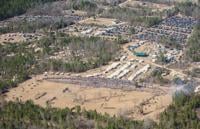
Currently the land along most of the park's boundary is already developed, primarily as single-family residences and subdivisions, but in some cases as commercial and light industrial development. Four acres were recently added to the park when a citizens' group, the Kolb Farm Coalition, formed to oppose the construction of a convenience store/gas station across the road from the Kolb farmhouse, the only period structure on park property.

The coalition used a combination of private donations and state and county money to purchase the four-acre site which was then transferred to park ownership.

Preservation of three relatively undeveloped areas along the park boundary has been identified by the Park Superintendent as critical:a 13-acre tract on the northeastern boundary, a 96-acre tract on the west central boundary, and a 10-acre tract along the southeastern boundary.

The cost estimate for saving the first tract is $170,000-$180,000 an acre, for saving the second tract is $110,000-$120,000 an acre, and for the third tract $70,000 an acre. As of the writing of this article, 67 acres of the second tract have been sold to a developer.

On the positive side, a project currently in the works, but not yet completed, will be the acquisition and preservation of the Wallis House, a period farmhouse that has remained in the Wallis family from the time of its construction in the late 1850s to the present. The house was used by Maj. Gen. O.O. Howard, IV Corps commander, as his headquarters for a short time in mid-June 1864.

Major funding for this effort came from a Georgia Civil War Commission grant of $125,000, coupled with $75,000 from Cobb County's share of the governor's Green Space Program Fund. The plan is to turn the 1-1/3-acre site over to the National Park Service to be administered by Kennesaw Mountain NBP as an out parcel which will, in the future, be developed as a new tour stop.

The county is also preserving, as a passive green space park, the top of an adjacent hill, which served as Howard's signal position.

Another major problem facing Kennesaw Mountain is vehicular traffic. Funds were never appropriated for the construction of the planned internal park tour road. Only two miles of exclusively park roads exist:the Cheatham Hill Drive and the Kennesaw Mountain Drive.

Other roads in the park are state and county maintained roads, six of which have become major channels for morning and evening commuter traffic. A conservative estimate would be that 50,000 cars pass through the park daily.

With the dramatic increase in traffic comes pressure to add additional traffic lanes. In one instance this can only be done with the loss of original earthworks and in all cases the loss of serenity expected in a national battlefield park.

A final problem facing the park is that it is being loved to death, not by Civil War enthusiasts as the representative national battlefield of the Atlanta Campaign, but by the burgeoning population of the Atlanta metropolitan area, as sadly the battlefield is one of the few available free islands of green space and solitude to be found in the region.

The park's 16 miles of walking trails and green fields are an irresistible magnet for those wanting a quiet walk or in search of an aerobic training area.

In the final analysis Kennesaw Mountain National Battlefield Park faces the same problem faced by any other battlefield caught in the tidal wave of suburban sprawl.

How do you balance the needs and desires of the local population for easier movement of traffic and passive recreational park space with the National Park Service's mandate to preserve and protect for present and future generations a historically significant site?

Willie Ray Johnson has been Historian at Kennesaw Mountain NBP for three years and on the park staff since 1974, performing various duties. During the years that he served as a seasonal ranger he was a public school history teacher, retiring with 32 years

Historical Publications Inc.
234 Monarch Hill Rd.
Tunbridge VT 05077


Our email address is:
mail@civilwarnews.com

Editorial, Subscriptions, Free Sample, and Advertising:
(800) 777-1862
Fax:
(802) 889-5627