
Civil War News
For People With An Active Interest in the Civil War Today

Home / Calendar / News Stories / News Archive / Preservation Columns / Book Reviews /
Living History
/ News Briefs / Subscriptions / Testimonials / Artillery Safety Rules
Photo Galleries / Feedback / Links


Saving Cedar Creek

By Joseph W.A. Whitehorne


October 2004

Almost exactly 140 years ago the final great battle of the 1864 Shenandoah Valley Campaign ran its red course at Cedar Creek. Confederate forces led by General Jubal Early staged a daring five column converging attack in the early hours of an idyllic autumn morning. They smashed through the sleeping Federal camps, seeming to precipitate a devastating rout.

However, Federal leaders did not panic and, supported by the brilliant defensive fighting of several of their key units, they eventually turned the tables on their opponents. The determined leadership of federal commander General Philip Sheridan converted the potential disaster into a decisive victory.

The triumph smashed Confederate military power in the Valley once and for all. It also caught the imagination of Northern voters who saw in it further validation of President Abraham Lincoln's strategy for victory, virtually assuring his re-election.

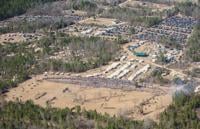
A frequently used site throughout the war, the battlefield saw its last sizable Federal camps break up in early November and once again it returned to the rhythms of peace. Slowly the earthworks, tent-sites and buildings left behind by the soldiers succumbed to agriculture's needs.

The pace of change was slow and there was little concern for preserving the battlefield and its vestiges because there seemed to be little threat. Its eradication was unthinkable.

This view began to alter in the 1970s as the pace of change accelerated in the northern Valley. The opening of two interstates contiguous to the battlefield's core area encouraged population growth and industrial development.

Community leaders in the southern part of Frederick County met in the summer of 1985 to discuss preservation strategies. The specific threat that catalyzed their concern was a proposal for construction of a light industrial park on battlefield land contiguous to the National Trust's Belle Grove Plantation.

A local developer had planned and received county approval for development of five factory sites on the 158 acres of land north of Belle Grove. It was this situation that inspired the community leaders' action.

They conceived an educational outreach program, and formed the "Cedar Creek Circle" which held a series of well-advertised and well-attended lunch meetings, over the next 18 months. The Circle developed an advisory network of local citizens and professional specialists in preserving and protecting the Cedar Creek Battlefield.

It sponsored also a series of lectures by distinguished scholars such as Gary Gallagher and Ed Bearss to educate further the public and to increase awareness of the threat to the land. Eventually Belle Grove and Lord Fairfax Community College combined to enlist Department of the Army support to save the battlefield.

The Secretary of the Army, John O. Marsh Jr., provided assets to develop a tour and guide book for the battlefield. He scored additional publicity by leading his senior officers on a tour of the battlefield in October 1986.

Despite these efforts, the developer continued planning to use the land for factories. As a result, some Circle members decided to form the Cedar Creek Battlefield Foundation, a not-for-profit organization, to purchase the 158 threatened acres. It was incorporated in October 1988 and, thanks in part to a gift/purchase agreement from the developer, it set out to buy the land.

One of the founding members, Stanley Hirschberg, M.D., remains on the Foundation board. The Foundation is an independent Virginia corporation that relies almost entirely for its existence and mission attainment on private donations. The reenactor community has been especially generous in supporting its efforts to preserve portions of the battlefield.

Interestingly, the first public entity to provide monetary support was the State of Vermont. Since then Virginia, Frederick County and the Federal Government "" thanks to U.S. Representative Frank Wolfe "" have provided funds. But, it is the continued loyal support of the reenactors and private friends of the battlefield who always provide the necessary base to carry on.

The Foundation board was especially moved at the spontaneous generosity of those at the 2003 reenactment who responded to news of its especially strained condition last autumn. It follows that the primary source of funds is the annual reenactment weekend which the Foundation tries to make as accommodating and enjoyable as possible to participants.

In 1996 the Foundation retired its debt on the original 158 acres and purchased a commercial building on three acres contiguous to it. This was paid off in 2000. Subsequently, the Foundation purchased 12 acres contiguous to the three acres and retired its debt on that in 2001. In 2000 the Foundation purchased a 135 acre tract containing valuable Civil War earthworks on the high ground above Cedar Creek, and is currently engaged in raising funds to pay off the loan on that.

This need to meet mortgage payments has curtailed the ability to realize its other objectives. However, the help of volunteers and interested organizations has allowed the Foundation to maintain some momentum in other areas of preservation and interpretation.

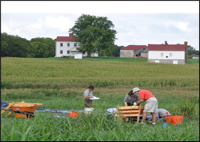
Archaeologists from James Madison University have surveyed the property at cost. The members of the Mahoning Valley, Ohio, CWRT cleared and marked a trail along the recently purchased earthworks. The Blue and Gray Education Society provided substantial funding and technical support for 11 interpretative signs while men from the Gaston, N.C. Confederate History and Monument Preservation Society provided the labor to install them.

The American Civil War Round Table of the United Kingdom commissioned a Keith Rocco painting that was raffled as a fund raiser. Such support and that from many other friends sustains the Foundation in its mission.

Its board looks forward as an independent property holder to increasingly close cooperation with the National Park Service as the new partnership battlefield park evolves over the next few years while it continues to be grateful to the reenactor community for its interest and support.

For further information about Cedar Creek Battlefield write P.O. Box 229, Middletown, VA 22645; call (540) 869-2064; e-mail cedarcrk@visuallink.com; or visit www.cedarcreekbattlefield.org


Joseph W. A. Whitehorne, president of the Cedar Creek Battlefield Foundation, is a professor of history at Lord Fairfax Community College, Middletown, Va., and the author or co-author of 19 books on a wide variety of military history topics.

Historical Publications Inc.
234 Monarch Hill Rd.
Tunbridge VT 05077


Our email address is:
mail@civilwarnews.com

Editorial, Subscriptions, Free Sample, and Advertising:
(800) 777-1862
Fax:
(802) 889-5627