
After working in battlefield preservation for 13 years with the Arkansas Historic Preservation Program, I have seen both victories and defeats in the struggle to save the state's Civil War-related properties. A recent incident provided a dramatic illustration of the importance of preserving Civil War battlefields and will inspire my efforts for years to come.
It started when Bill J. Gurley of the University of Arkansas for Medical Sciences, an author and avid student of the war, called late last fall to report that friends of his visiting a recently clear-cut area of the Helena battlefield had discovered long bones protruding from the soft loess soil of a finger ridge north of Battery D.
We arranged to visit the site with Dr. John House of the Arkansas Archeological Survey, accompanied by archeologists John Connaway and Jessica Crawford.
As we approached the reported location of the bones we traversed an area that had been devastated by the effects of the clear-cut. Great gouts were ripped from the hillsides where soldiers of the 35th Arkansas Infantry and Hawthorn's Arkansas Regiment had struggled toward Battery D in the sweltering heat of July 4, 1863. Huge masses of bark left from a temporary sawmill set up to process the clear-cut timber lay rotting in the sun. The entire end of a ridge was sheared off. Already the increased effects of erosion were readily apparent.
We soon began climbing a new road cut into the ridge where the bones were reported. We immediately saw evidence of a disturbed burial "" pieces of skull, sponge-like bone fragments, human teeth "" already washing down the hillside. A quick examination revealed that it was indeed a grave site that had been disturbed by the tree removal.
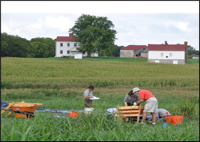
Following an investigation by the Helena Police Department to determine that the remains were not recent, John House led a recovery operation in May, assisted by Gurley, Connaway, Crawford, archeologists Kate Wright and Jay Mitchell and, to a small degree, myself. As the earth surrounding the bones was slowly shaved away, it soon became apparent that there were several soldiers here, apparently rolled into a burial trench on that hot July afternoon 140 years ago as victorious Northern troops dealt with the scores of dead Confederates.
The bones of six distinct individuals were found stacked in this battlefield grave. None of the skeletons was whole; Dr. House theorized that a tree had grown atop the grave where these Arkansas soldiers had lain in honorable rest since 1863. When the tree was torn from the ground during the clear-cutting operation, the grave was shattered as the root ball broke free, scattering bones and perhaps dragging others away, still entangled in the roots. Other bones were crushed by the heavy timber-clearing equipment, and some simply washed away.
Arrangements are now being made for these remains to be reburied in the Helena Confederate Cemetery, where dozens of their fellow soldiers who died at Helena that Fourth of July now rest near the grave of Helena's Patrick Cleburne.
The bones of these Arkansas men will return to the earth, but the battlefield area from which they were removed is lost, a stark example of the continuing importance and relevance of battlefield preservation.
- - -
While the incident in Helena was appalling, it should not overshadow the impressive steps being made elsewhere in Arkansas to identify and preserve the state's Civil War-related properties.
In Jacksonville, the Reed's Bridge Battlefield Preservation Association is acquiring significant portions of the core area of an Aug. 27, 1863, battlefield that stretches along Bayou Meto. This small but active organization helped get the battlefield listed on the National Register of Historic Places and has applied for an American Battlefield Protection Program grant for preparation of a preservation plan for the battlefield. The effort at Reed's Bridge is the most active battlefield preservation initiative in Arkansas.
The Arkansas Civil War Heritage Trail (ACWHT) "" a network of regional organizations dedicated to identifying, protecting, interpreting and promoting the state's Civil War-related properties "" continues to make great progress.
The newest group, the West Central ACWHT, is working with the City of Fort Smith to make improvements at the Massard Prairie Battlefield Park, site of an 1864 battle in which Confederate Native American troops settled old scores with several companies of the 6th Kansas Cavalry. The Kansans' camp site is included in an area donated to the city several years ago.
The Southeast ACWHT has participated in the National Park Service's Vicksburg Campaign Trail study, helping to identify and document sites in the region that played a role in the struggle over that Mississippi River bastion. Arkansas Post and Helena are both primary sites in the study, but the SEACWHT also is working on less-storied sites such as Fort Pleasants and the Camp White Sulphur Springs Cemetery. The group also is working to place additional interpretation at sites associated with the 1864 Camden Expedition and has helped to document additional battle locations.
The Southwest ACWHT is participating in preservation efforts at the Jenkins' Ferry Battlefield, Fort Lookout in Camden, and other sites associated with the Camden Expedition that were designated as National Historic Landmarks in 1994. SWACWHT members also plan to assist the Arkansas Historic Preservation Program in identifying and mapping fortifications and camp sites established along the Red River in 1864-65.
The Central ACWHT put the Little Rock Campaign of 1863 on the map with a series of interpretive wayside panels at seven key locations associated with the campaign, then connecting the panels through a driving tour map. The group is continuing its support of Civil War properties in its area.
The Northeast ACWHT has prepared a series of brochures about Civil War battles and related sites in its region, establishing a "paper trail" that will be made more concrete as interpretive wayside exhibits are put in place. The group's efforts are augmented by the presence of the Crowley's Ridge National Scenic Byway, which encompasses much of northeast Arkansas.
The "grandfather" of the ACWHT groups, the Northwest Arkansas ACWHT, continues its labors in the fastest-growing region of the state and the location of two of Arkansas's most famous battles, Pea Ridge and Prairie Grove.
The NWACWHT helped develop an Arkansas Civil War curriculum for school children, created a regional driving tour brochure, and hosted a heritage tourism seminar that attracted people from several states. The group is actively identifying other sites that are threatened by the area's rapid development.
(To read the most recent issue of the Arkansas Battlefield Update, the publication of the ACWHT, use this link:http://www.arkansaspreservation.org/history/publications.asp.)
All six ACWHTs are working together to form the Arkansas Civil War Heritage Trail Foundation and gain non-profit status so that they can better raise funds to preserve Arkansas's Civil War-related sites. The Foundation should prove to be a key player in battlefield preservation in Arkansas.
At the state level, the Arkansas Historic Preservation Program, an agency of the Department of Arkansas Heritage, coordinates technical support for the ACWHT groups. The AHPP also has been actively recording the locations of previously undocumented Civil War sites and mapping them using GPS technology.
Numerous Civil War-related properties "" including the Bayou Meto (Reed's Bridge) Battlefield, fortifications at Wittsburg and Camden, and a Camden Expedition-related shipwreck "" have been listed on the National Register of Historic Places through the agency's efforts, and other nominations will be pursued in the future.
While much has been done, much more remains unfinished in the crusade to preserve Arkansas's battlefields. Through the efforts of dedicated volunteers, we hope that such incidents as that at Battery D in Helena will never occur again.
Mark K. Christ is community outreach director for the Arkansas Historic Preservation Program, where he works with people around the state to identify, protect, interpret and promote the state's Civil War-related properties. He is the author of Getting Use