Laurel Hill Battlefield
Where the past is present
By Lynne Llewelleyn Snyder
(December 2008 Civil War News - Preservation Column)
The Civil War Battlefield of Laurel Hill, situated in Belington, W.Va., saw decisive action in 1861. It was during July 7-11 that the longest battle of the Tygart Valley Campaign was waged in what was then known as Bealington, Va.
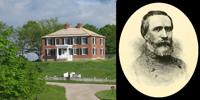
Generals Robert S. Garnett, CSA, and George B. McClellan, USA, engaged their forces in a vital contest that sent the Confederate Armies scurrying to anticipated safer quarters, only to result in the first war casualty of a general during the Civil War: Garnett met his death at Corrick’s Ford.
One of his statements can be found in Rebels at the Gate byW.Hunter Lesser (Sourcebooks 2004): “I don’t anticipate anything very brilliant — indeed I shall esteem myself fortunate if I escape disaster.”
The Battle of Laurel Hill is known for its pivotal role in securing safe passage to Wheeling for the founding fathers of the present-day West Virginia, in order to prepare the necessary documents that would establish the statehood of West “by God” Virginia.
Several decades later, the Department of Transportation, Division of Highways, installed identifying signs in strategic locations, announcing the significance of Laurel Hill in the Civil War and encampment locations.
A long period ensued without any further attention to these hallowed grounds. Then, in the mid-1990s, came a collective reckoning voice that sought the preservation of this historically valuable property.
Larry Corley of Philippi and Kathy Hart from Belington, both members of the Battle of Laurel Hill Foundation, met with Sen. Jon Blair Hunter, (D.14th District) to request financial assistance in purchasing the battleground acreage. Through the efforts of these dedicated pioneers and the diligence of their senator, the state of West Virginia, under the administration of Gov. Bob Wise, agreed to appropriate the needed monies for this endeavor.
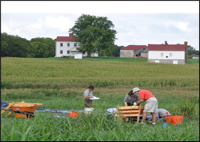
During the period of processing paper work, having an appraisal, survey and an archeological dig scheduled, it was necessary to provide matching funds to receive the Transportation Equity Act TEA-21 grant money.
The generosity of the Benedum Foundation provided this needed contribution. Seed money for the operating expenses of the foundation was made available by the Budget Digest sources and were directed to the living history of Laurel Hill Battlefield.
The property owners of the desired portion of the battlefield, Ida and Al Griffith, agreed to sell 50 acres and retain other ground to sustain residence in their home. As the negotiations were in place, and as the hoped-for purchase was being arranged, the Griffiths gave permission to the Reenactment Committee for the Battle of Laurel Hill Reenactment to take place.
Chairmanship of this activity is a joint venture between the Battle of Laurel Hill Reenactment Committee (BLHRC) and the Valley Division, under leadership of Maj. Roger House. Representing the committee was Kathy Hart, president of the BLHRC. This event completed its 13th year in 2008 and is scheduled in 2009 for the third weekend in July.
Finalization of the transaction was celebrated in December 2003, with the deed presented to the City of Belington in January 2004. Since that time, continued enhancement has been ongoing.
Key players in the development of the battlefield were Don Richardson and W. Hunter Lesser, Don Richardson Associates; Jeff Nelsen, Environmental Design Group and Floyd Browne Group; Mike Gioulis of Gioulis Historic Preservation Consultants; and, of course, the City of Belington.
Some of the additions, enhancements and improvements through the grant funding have been the interpretive signage, a “past and present” bridge, walking trails, a desperately needed water well system and flag pole and flag installations (by the Valley Division). The Valley Division also has plans to replace a footbridge on the battlefield perimeter.
Early interpretive signs include one along the Beverly Fairmont Turnpike that poses Ambrose Bierce, a noted American author, who is quoted as saying: “We did well enough considering the hopeless folly of the movement, but we came out of the woods faster than we went in.…”
In an attempt to perpetuate and preserve the historic link to the past, a series entitled, “Letters Home,” was published in the Barbour Democrat, the Barbour County newspaper. The letters were supplied by Jane Pendleton Wooten of Richmond, Va., and they had been written by her great-great-grandfather, Sgt. John Barret Pendleton, CSA, while he was in service at Laurel Hill in July 1861.
Bus tours from as far away as Missouri have been to the site. The pristine beauty lends an attractive and quiet reverence to the somber visions that are conjured up about the engagement of so long ago that was so significant in the developments of the Civil War, the War Between the States or the War of the Rebellion — all the titles having the same meaning — a fight of brother against brother.
Recent efforts have been in action to secure funding to build a visitors center on the site and, even more recently, the West Virginia State Historic Office of Preservation declared that Laurel Hill, indeed, has what it takes to be eligible for nomination to the National Register of Historic Places.
Another noteworthy item is the Civil War Trails sign that was placed on the corner of Watkins Avenue and Crim Avenue. This was the first of its kind to be installed in 2005. These signs extend from Wheeling through Corrick’s Ford and beyond, tracing the Civil War path through Virginia (now, West Virginia).
A diamond in the rough, a legacy in slumber, is in the process of emerging to its rightful place in the tragic, historic accounting of Civil War history.
An eerie, ghostly insistence has beckoned for recognition. These soldiers are honored by those who sense the need to continue a living tribute to their contribution in forming this country.
Seekers may find further information at www.battleoflaurelhill.org
Laurel Mountain Reenactment Foundation Vice President Lynne Llewellyn Snyder is a recent retiree and recent graduate of the Master’s in Education program, with a concentration in Online Learning, at Fairmont State University. She has been honored by the Barbour County Chamber of Commerce and is involved in community service. |