

Civil War News
For People With An Active Interest in the Civil War Today

Gettysburg Battlefield Work Begins With Thicket Clearing
By Deborah Fitts
GETTYSBURG, Pa.

A raging controversy over construction of a new visitor center and museum at Gettysburg hogged the headlines for years. But now it is another part of the park's wide-ranging new General Management Plan (GMP) that is capturing attention, as the long process of implementation begins.
The GMP's ambitious vision to return the battlefield to its wartime appearance will start with a demonstration project at one of the most visible and most compelling - though not heavily visited - spots: the woods in front of the Pennsylvania Memorial where a Confederate charge July 2, 1863, threatened to breach the Union line. A desperate countercharge by the 1st Minnesota saved the day.
Today visitors have difficulty appreciating the action, since a thicket of second-growth shrubs and young trees comprising a dozen acres has been transformed in the intervening 138 years to 27 acres of mature woods. That's why cannons along the Union line on Hancock Avenue aim blindly at a wall of trees instead of the advancing Confederates.
During the battle, "there really wasn't anything there to speak of," says Marcus Pratt, a historical landscape architect at the park and project manager for restoration of the "Codori-Trostle thicket." The two families of the adjoining farms had only recently cleared out the useful wood, leaving to grow a Wilderness-style tangle of slash.
"Soldiers complained that [the thicket] was hard to get through," Pratt notes. A typical description by a battle participant recalled "a low woods, with lots of underbrush, bushes and boulders."
The fact that the shrubbery was only 10 to 15 feet high and grew in the low, moist ground along Plum Run meant that the opposing sides could see over it -- and see their enemy coming from a great distance - something that is impossible today.
In other words, as the 1st Minnesota moved towards its fate "they would have fully understood what they were up against," Pratt said.
Tom Vossler, a Licensed Guide who specializes in the action here, notes that if the present screen of mature trees were in place in 1863, Union Gen. Winfield Scott Hancock would not have been able to see the oncoming Confederates of Gen. Cadmus Wilcox's brigade, and would not have summoned the 1st Minnesota.
Of the 262 soldiers who made the charge, 215, or 82 percent, were casualties - "the highest percentage loss of a single unit in a single battle engagement in the entire war," Vossler says. "As guides," he adds, "one of the biggest challenges we face is being able to create for the visitor a true picture of what the terrain looked like. When you talk about it, you have to use words like 'Imagine, if you will.'"
The 1st Minnesota's sacrifice clearly prevented Wilcox from getting behind the Union line, but it's nowhere near as well known as the 20th Maine's counterattack farther to the south that afternoon, on Little Round Top. "Perhaps because it's been consumed by the landscape," Vossler says.
How do park historians know about the thicket? Pratt points to a wealth of contemporary maps, soldier accounts and about 40 photographs, including a photo taken right after the battle from Little Round Top that has been enlarged 800 to 900 percent and digitally enhanced, and provides "a beautiful view of the area. The detail is just incredible."

This prototype project of the GMP will be followed by more over the years.
All told, the park intends to remove 576 acres of non-historic woods (the park boundary includes 5989 acres), replace 115 acres of historic woods now missing, maintain 65 acres of thickets at their historic height, manage 278 acres of woodlots, replant 160 acres of orchards and rebuild 39 miles of fence.
Just how to restore the thicket is something the park has been puzzling about for years, Pratt says. The answer that has emerged is: very cautiously.
"We have no intention of clear-cutting," says Pratt. "We've been consulting how to do this in a very environmentally friendly way." The park earlier commissioned studies on flora and fauna, wetlands and water quality.
As a first phase they will cut the non-historic woods that have grown out like "fingers" from the original thicket. Plans call for removing entirely 16 of the 27 acres of woods. Then they will address the remaining 12-acre thicket area, gradually removing the mature trees, none of which dates to the battle, and selectively eliminating non-native shrubbery such as barberry and multiflora rose, to encourage the low-growing native redbud, dogwood and sumac. They will fence out cattle and replant native species as necessary.
Assisting the park is the Olmsted Center for Landscape Preservation in Brookline, Mass., another National Park Service facility, which is writing three documents prior to implementation - a site history, a restoration plan, and a maintenance plan. The first two are expected in June and the third by August.
The study area of which the thicket is the focus (the park has been divided into 26 study areas - a "quilt" of the battlefield - for the GMP restoration) also includes land where orchards existed at the time of the battle, on the Trostle, Codori and adjoining Klingel farms.
So the plan also calls for replanting 4 to 5 acres of fruit trees, plus scattered trees that dotted historic fencelines.
And it calls for erecting fully 1.8 miles of new fencing near the thicket, and restoration of a farm lane that began at the Emmitsburg Road just south of the Codori barn and ran toward the thicket.
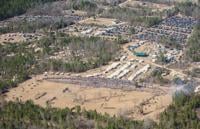
The lane, whose trace is visible in an aerial photo, "would have been an avenue of approach" for the Confederates, Pratt notes. Cutting should start later this year, according to Pratt. It could take five years overall, but he predicts "signficant" opening of the view within a year.
Delineation of the lane will actually be the first and most visible project in the study area. The Friends of the National Parks at Gettysburg are organizing a fence-building weekend for volunteers June 17-18 with a goal of 1500 feet of new fence along historic fencelines.

But for Pratt, the restoration of the thicket will be the most "fantastic" aspect of the project. "It's an area that's now so obscured, and it wasn't historically obscured," he says. "It's got to be one of the highest interpretive possibilities for landscape interpretation we have."

Use these links to navigate on CWN's web site

Home/ Calendar/ News/ Opinion/ Book Reviews/ Civil War on the Internet/ Living  History/ News Briefs/ Subscriptions/ Testimonials/ Artillery Safety/ Feedback/ Links

Historical Publications Inc.
234 Monarch Hill Rd.
Tunbridge VT 05077

Our email address is: mail@civilwarnews.com

Subscriptions: (800) 777-1862
Free Sample: (800) 777-1862
Display Ads: (800) 777-1862
Editorial: (802) 889-3500
Fax: (802) 889-5627