
Civil War News
For People With An Active Interest in the Civil War Today

Home / Calendar / News Stories / News Archive / Preservation Columns / Book Reviews /
Living History
/ News Briefs / Subscriptions / Testimonials / Artillery Safety Rules
Photo Galleries / Feedback / Links


CWPT To Pay Record 12 Million For 205-Acre Slaughter Pen Farm

Deborah Fitts

(May 2006)FREDERICKSBURG, Va. - In the costliest-ever purchase of a battlefield by a nonprofit, the Civil War Preservation Trust (CWPT) has an agreement to buy the infamous Slaughter Pen Farm for $12 million.

The 205-acre property, fronting historic Tidewater Trail on U.S. 2 south of Fredericksburg, was named by the veterans who recalled their violent clash there Dec. 13, 1862.

Trust President James Lighthizer called the deal "the most ambitious nonprofit battlefield acquisition in American history." He added, "We will raise the money needed to save this historic treasure - because we must."

Trust spokesman Jim Campi called the farm "probably the most blood-soaked ground we have ever acquired," noting that 5,000 casualties incurred on the property. He also cited the "rarity" of the land.

"There's no other place on the Fredericksburg battlefield where you can follow the attack by the Union army from beginning to end," he said. Residential development elsewhere, such as in front of Marye's Heights, has swallowed key parts of the battlefield, he explained.

Similar-sized or even larger battlefield properties typically sell in the $3 million to $4 million range, Campi said. But in this case, the fact that the site was zoned for industrial use, had railroad access and is in fast-growing Spotsylvania County boosted the value into the stratosphere - $60,000 an acre.

"This is a site where you could say without question that if we didn't get involved, it would have wound up being developed in a hideous way," Campi said. "We knew we had competitors, and we had to act quickly."

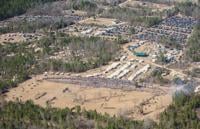
The farm, known locally as the Pierson Tract, is located immediately south of Shannon Airport, and lies across the railroad tracks from part of Fredericksburg & Spotsylvania National Military Park. Campi noted that the property is the largest remaining unprotected portion of the Fredericksburg battlefield.

The Trust began highlighting the importance of the farm three years ago, and has been actively attempting to buy it for a year from owner John Pierson. Last spring the Spotsylvania County School Board considered the property for an elementary school, but the Spotsylvania Battlefields Coalition, a union of preservation groups spearheaded by the Trust, opposed the idea, and in July the school board backed down.

Pierson died in August. The Trust approached his niece, who inherited the farm, but "I don't think she ever got over us stopping the school board," Campi said. The property went on the market in December for $12.3 million, touted as "one of the best industrial sites in the Commonwealth of Virginia."

"If we were going to save it, we had to pay developers' prices," Campi said. "That's all there was to it." He said the National Park Service is "extremely excited" about the purchase.

Park Superintendent Russ Smith said: "We view this as a rebirth of the Fredericksburg battlefield. Preservationists had long ago given up on maintaining a vista from Union to Confederate lines, but CWPT and Tricord have given this historic landscape a second chance."

In February, Tricord Inc., a local, family-owned development company, came to the Trust's assistance and purchased an option on the farm. Tricord recently cooperated with the Trust in preserving the former Mullins Farm at Chancellorsville. Campi said the company had the financial resources to move quickly to take the property off the market. Tricord and the Trust have an agreement that will turn the property over to the Trust.

The Trust's Lighthizer hailed Tricord for being "exceptionally community-minded. They gave of their time and talents to secure this property without any benefit other than the satisfaction that they were helping to save hallowed ground."

The Trust hopes to close on the property in June, according to Campi. He said there will likely be considerable contributions from federal, state and local government sources. Public grants will be leveraged with private-sector donations from Trust members, corporations and other conservation groups, he said.

Lighthizer predicted "an unprecedented response for this fundraising effort from our members and all those who care about this great nation."

The Fredericksburg-based Central Battlefields Preservation Trust (CVBT), which has worked for years to support preservation of the Slaughter Pen Farm, will play a significant role in the fundraising campaign, according to CVBT President Mike Stevens.

Stevens commented, "Standing on that last unblemished landscape, where so many men gave their lives on a cold winter day, it is clear that such sacrifice and valor must be preserved to inspire future generations."

Ed Bearss, Chief Historian Emeritus of the National Park Service, said the farm is "without a doubt the most significant part of the battlefield at Fredericksburg that is not protected."

Fredericksburg & Spotsylvania National Military Park Historian Frank O'Reilly recalled that on Dec. 13, 1862, Union artillery positioned in a muddy field at the farm, "soon to be known as the slaughter pen," fired on Confederate forces for several hours prior to the Federal assault. At noon two Northern divisions under generals George Meade and John Gibbon began their attack, only to be halted by artillery under Confederate Gen. Stonewall Jackson. "Union and Confederate guns dueled for an hour," according to O'Reilly.

Meade and Gibbon resumed the attack at 1 p.m. "Meade's men penetrated a gap in the Confederate line and fought their way into the heart of Jackson's defenses." The Confederates stopped Gibbon's advance, however, and he launched a second and then a third attack. The final assault drove the Southerners from the railroad embankment, with hand-to-hand fighting.

Jackson's men rallied and repulsed the Union assault by 2:30 in the afternoon - but not before their pursuit of the Federals into the muddy field gave an opening to the Union guns, "which cut them down in droves." Five Medals of Honor were earned in the open field dubbed the Slaughter Pen. According to O'Reilly, one of the best-known phrases of the war was prompted by the bloody results of the day. "Gen. Robert E. Lee was moved by the destruction in the Slaughter Pen, uttering his famous observation, 'It is well that war is so terrible, or we would grow too fond of it.'"

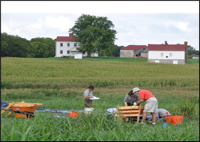
Campi said the Trust may plan to interpret the Slaughter Pen Farm. The property comprises mostly cultivated fields with a farmhouse and several farm structures. Ultimately, he said, the Trust hopes to turn it over to the battlefield park, which would require a congressionally approved boundary adjustment.

With 75,000 members, the Trust is the largest nonprofit battlefield preservation organization in the country. Since 1987 the organization has saved more than 22,000 acres. For information go to www.civilwar.org

Historical Publications Inc.
234 Monarch Hill Rd.
Tunbridge VT 05077


Our email address is:
mail@civilwarnews.com

Editorial, Subscriptions, Free Sample, and Advertising:
(800) 777-1862
Fax:
(802) 889-5627