
Civil War News
For People With An Active Interest in the Civil War Today

The Private Sector as Stewards of History: Pamplin Park
By Richard Lewis
June 2002

Those involved in the crusade to preserve and protect our historic resources come from a variety of backgrounds. This is the story of how a privately-owned, non-profit organization is succeeding in both Civil War preservation and education.

In the fall of 1864, Gen. Robert E. Lee sought to protect his lines of supply into Petersburg, Va., by extending his defensive line southwestward from the main ring of fortifications surrounding the beleaguered city. Massive earthworks were constructed, the line crossing streams, fields and farms.

It was along this extended line that Lt. Gen. Ulysses S. Grant decided to launch a battering ram at-tack expected to puncture Lee’s thinly-manned defenses and put an end to the campaign of Peters-burg. On the early morning of April 2, 1865, Grant sent his veteran 6th Corps hurtling at his objective, a point on the Confederate line along a swampy stream on the Boisseau farm.
Though one Union officer called the Confederate fortifications there "the strongest works in North America," the assault was spectacularly successful. Sixth Corps soldiers surged up and over the earthworks, routing the badly-outnumbered Confederates and blasting a hole in Lee’s line that would not be repaired. Lt. Gen. A.P. Hill, riding to his threatened sector, was shot from his horse near the Boydton Plank Road.

With his army in grave jeopardy, Lee withdrew his forces across the Appomattox River, evacuating both Petersburg and Richmond. His surrender occurred just one week later.
In the early 1990s, the tract of land containing the site of the 6th Corps breakthrough became available for purchase. With surrounding lands zoned for industry or clear-cutting, it was imperative that this parcel be salvaged and preserved.

Enter Dr. Robert B. Pamplin Jr., one of America’s top businessmen and philanthropists. Dr. Pamplin and his father, Robert B. Pamplin Sr., operate the R.B. Pamplin Corporation, a Fortune 500 company. They also administer the interests of the R.B. Pamplin Foundation, a family trust through which countless charitable, educational and preservation projects are funded.

The Boisseau plantation on which the breakthrough battle was fought, belonged to the elder Mr. Pamplin’s maternal ancestors but passed out of family hands after the Civil War. Dr. Pamplin saw the acquisition of the land as an opportunity not only to save an endangered battlefield but also to re-claim a part of his family heritage.

The Pamplin Foundation provided the funds to purchase the battlefield, with plans to build interpretive trails and a museum. Soon the original Boisseau plantation house and its surrounding acreage was added and Pamplin Park Civil War Site was opened to the public in 1994.
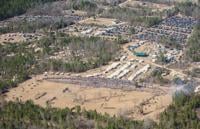
This was the genesis of what is now the $30 million, 422-acre Pamplin Historical Park & The National Museum of the Civil War Soldier, an award-winning facility that many consider to be the finest Civil War attraction in the country.

Containing not only the battlefield but also three antebellum homes, an original slave dwelling and outstanding museums, the park interprets both military and civilian life during the Civil War. In 2002, school groups comprised of more than 30,000 students will visit the park and take in its excellent educational programming.

Though the Park’s approach to education and interpretation garners most of its awards, just as important is its tri-fold preservation effort. Pamplin Historical Park is home to a vast artifact collection numbering over 5,000 items. Four antebellum structures must be cared for. The battlefield contains some 3/4 mile of original Confederate earthworks which rank among the best preserved of their kind.

Pamplin Historical Park is one of the few facilities that manages a large artifact collection, historic structures and a battlefield, and the task to preserve and present these elements is both daunting and expensive. William C. Lazenby is the park’s director of history, museums and cultural resources.

As the person charged with managing the park’s preservation efforts, Lazenby is fully cognizant of both the privilege and responsibilities incumbent on him.

"When you consider the scope and diversity of our project, you realize that the opportunity here is uncommon," he says.

It must also be noted that such an effort requires an enormous financial commitment. "Such a task as this would hardly be possible except for the vision and commitment of our benefactor," says Lazenby.

Indeed, Dr. Robert B. Pamplin Jr. is not only the financial backer of the park that bears his family name, he has also provided the vision and direction behind the concept of the park. Pamplin’s efforts were recognized this year when he was presented with the Oliver Wendell Holmes Jr. Award. The award is given annually by three chapters of the Civil War Round Tables of Massachusetts and recognizes an individual for outstanding contributions in the field of Civil War education, preservation and restoration.

Dr. Pamplin’s commitment to preservation has an able and sympathetic executor on site in the per-son of historian A. Wilson Greene, Pamplin Historical Park’s executive director. Greene long ago made his mark as a preservationist as the head of the Association for the Preservation of Civil War Sites. His background also includes a lengthy tenure in the National Park Service. He thus brings to the park the point of view of someone who has valuable experience not only in preservation but also in administration.

The initial purpose of the park was to preserve, protect and interpret the battlefield. The park’s philosophy is to give its visitors the best possible interpretation of the battlefield while fulfilling to the maximum its obligation to preserve.

A well-defined trail system is in place and is highlighted by historical waysides and interpretive displays. Nowhere is there any encouragement for visitors to walk on the earthworks. Park rangers conduct regular patrols of the trail and are vigilant in keeping trespassers and relic hunters off the property. The maintenance staff sees to the management of vegetation, removing trees that are likely to cause damage to the earthworks. Animal dens are filled in and patched. Any erosion problems are quickly identified and repaired.

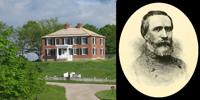
Pamplin Historical Park also maintains and interprets four historic structures. The Boisseau home, Tudor Hall, dates to 1812 and was used during the Petersburg campaign as the headquarters of Confederate Brig. Gen. Samuel McGowan. The Hart House, an 1850s structure which is not yet open to the public, sits near the park’s southern boundary and was the scene of action not only at the 1865 breakthrough but also during the 1864 battle of Peeble’s Farm.

The Banks House, which sits on a 7-acre parcel just off the park’s main boundary, was acquired in May 1999. Portions of the house were already 100 years old when it was used as headquarters by Lt. Gen. Ulysses S. Grant on April 2-3, 1865. Behind the Banks House sits an original kitchen/slave quarter.

The fabric of each of theses structures had to be stabilized before beginning the process of restoration. Each has now been returned to its wartime appearance. Allowing the public access to these homes means stress on the original floors, stairs and walls. Nearly 30,000 school kids a year traipse through Tudor Hall. Protective coverings are necessary to maintain the integrity of the floors. Educators who accompany the school groups engage the students in becoming protectors of history by not damaging the house.

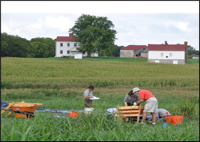
Pamplin Historical Park’s museum artifact collection presents its own challenges of preservation. Nearly 90 percent of the collection is on display at any one time and so Lazenby and his staff are constantly engaged in after-hours conservation efforts.

Uniforms and flags must be properly mounted so that stresses of gravity do minimal damage. Lighting is kept at a minimum and ultraviolet light is kept out entirely. The state-of-the-art HVAC system keeps the museum display areas at a constant temperature and humidity that are appropriate for the artifacts.

The effects of Pamplin Historical Park’s efforts to preserve and protect actually go beyond the park’s borders. Those who visit the park, particularly youngsters on field trips, gain an understanding and appreciation for history and come to value the tangible remains of that history. Perhaps among those fresh young faces are future leaders in Civil War preservation efforts.

Pamplin Historical Park & The National Museum of the Civil War Soldier is located just southeast of Petersburg at I-85, Exit 63-A and is open daily except Thanksgiving, Christmas and New Year’s Day. For more information on the park and its programs, call toll free (877)PAMPLIN or visit www.pamplinpark.org.

Historical Publications Inc.
234 Monarch Hill Rd.
Tunbridge VT 05077

Our email address is: mail@civilwarnews.com

Subscriptions: (800) 777-1862
Free Sample: (800) 777-1862
Display Ads: (800) 777-1862
Editorial: (802) 889-3500
Fax: (802) 889-5627