Civil War News
For People With An Active Interest in the Civil War Today

New Gettysburg Visitor Center Complex Is Unveiled — Cost $95M
By Deborah Fitts
Feb./March ’02 issue
GETTYSBURG, Pa.

A complex of buildings evocative of a 19th-century farmstead was the design unveiled Jan. 11 for a new museum and visitor center at Gettysburg National Military Park.

The park's private partner, the Gettysburg National Battlefield Museum Foundation, hopes to begin construction in "early 2004." The 139,000-square-foot facility will be more than triple the size of the current visitor center.

In a press conference at the Gettysburg Hotel, foundation President Robert Wilburn hailed the architect's plans as a successful expression of both the modern era and the past.

"We were determined to create a sense of place that evoked the emotions of 1863, while also meeting visitors' expectations of a 21st century museum experience," Wilburn said.

He also disclosed that the price tag for the project had jumped to $95 million, up from an estimate of $70 million. It was originally conceived at $39 million.

Architect Jaque Robertson, of the New York firm Cooper Robertson & Partners, said the intention was to tap into the "cultural gene bank" of south-central Pennsylvania in the mid-1800s. A mix of German, English, Quaker, Huguenot and Scotch-Irish traditions had created here "one of the most beautiful vernacular architectures in the United States," he said.
The new facility will be built off Hunt Avenue, two-thirds of a mile from the current visitor center. The present building dates from 1921 and has had 14 additions over the years. It will be razed, along with the adjacent Cyclorama Center, and the area will be returned to its wartime appearance.

"The issue at Gettysburg is the battle," said Robertson, and the challenge was to make the new complex fit in. "You could have put everything in a big box and put a sign on it and wrapped parking all around it and gone home," he said.

Instead, "We tried to build buildings which look as if they belong on the land, and reinforce the culture and the nature of the landscape. These buildings should be fresh and new and at the same time familiar."

The most difficult task was accommodating the giant Cyclorama painting, which will be housed at the center of the facility in a huge, circular building reminiscent of a Shaker barn. The highest point will be nearly 80 feet above ground.

"How do we put the Cyclorama in without overwhelming everything else?" Robertson said. "So we said, OK, we'll treat it like a giant barn and wrap everything around it."

All structures will be faced in wood, stone or brick to reflect local materials of the era. Although the complex has the illusion of being made up of several separate farm buildings, thereby breaking down the scale, the first floor of the facility will actually be continuous throughout.

A stone "silo" at the entrance will serve as a "decompression chamber," Robertson said, with light spilling from above onto a gallery of text and photographs — including Gettysburg's dead — designed to push aside the modern world and prepare visitors to experience the battlefield.

Robertson said his firm's job was threefold: managing the visitor experience in a "pleasant and rational" way, with a flow and scale that are "clear, comfortable and relaxing"; providing superior care of the park's extensive collection of artifacts and documents; and telling the battle story for a wide range of visitors, from the Civil War buff to the newcomer, in such as way as to "take them out of the 21st century and make them understand that what they think was ancient history in fact was yesterday."

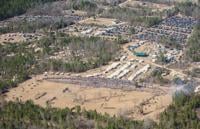
Foundation Vice President Suzanne Helm said the new facility will not be visible "from major points of interest" on the battlefield. Parking will accommodate 450 cars and 60 buses on the 45-acre parcel on Hunt Avenue that the foundation owns. A further 250 parking spots will be available at the adjoining "Fantasyland," site of a former amusement park.
Helm said the new building will get visitors "grounded" in the battle and then encourage them to go outside and see the landscape for themselves. With several trails leading to the battlefield, "We're trying to encourage more of a walking experience." Visitors may also, as now, drive their cars.

Helm said the rise in the expected cost to $95 million, compared to $70 million in November 2000, was due to an additional $10 million in construction costs, plus several millions more for offsite road and intersection improvements and more expensive "exhibitry." The facility is larger than originally planned, she said, in order to provide additional space to accommodate peak crowds.

The museum will be "artifact-rich," Helm promised. Typically, museums that feature a "story line," as this one will, are thin on artifacts, she said. "We're going to make an exception."

The original $39 million estimate, she said, was based on a "baseline box" building. Among the added costs is a $10 million endowment to be used for maintenance and repair.

Of the $95 million, $12 million will be acquired through commercial borrowing, and the rest from donations. To date the foundation has achieved 10 percent of its fundraising goal, Helm said, "which is where we want to be."

She noted that the campaign got under way in September, but in a "very minimal" fashion, and now will swing into action with appeals to foundations, corporations and individuals. "We really couldn't get started till we had a product to show," Helm explained.

Robertson said his firm was pleased to have been given the task of designing a new visitor facility for "one of the most important places in American culture."

"Gettysburg changed the meaning of freedom and liberty in the United States," he said. "This was a huge killing ground, but it was more than that. You can go through history and name the battles that changed the culture. This one did.

Gettysburg is at the level of myth. It is one of a half-dozen places that has that quality in American history."

Robertson, a Richmond native, has served at various times as a planning commissioner in New York City, dean of the University of Virginia School of Architecture, and advisor to the Aga Khan program of Study of Islamic Art & Architecture at Harvard and MIT, among numerous other positions.

The many projects undertaken by his firm include a master plan for Monticello and a waterfront plan for Memphis. The firm is preparing master plans for the expansion and renovation of the Lincoln Center, the new Shaker Museum & Library in Mount Lebanon, N.Y., and the new Museum of the City of New York.

Historical Publications Inc.
234 Monarch Hill Rd.
Tunbridge VT 05077

Our email address is: mail@civilwarnews.com

Subscriptions: (800) 777-1862
Free Sample: (800) 777-1862
Display Ads: (800) 777-1862
Editorial: (802) 889-3500
Fax: (802) 889-5627