Civil War News
For People With An Active Interest in the Civil War Today

The Making Of A Preservationist
Robert Lee Hodge May 2002

"If those works could be preserved by law, for the benefit of our curious posterity, they would last for many generations. Each battlefield would thus have its own monument to celebrate the events that transpired there; each rifle-pit and battery speaking more to the heart of the spectator than would whole volumes of history." -- Union soldier in 1864.

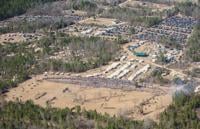
In June 1991 I stood for the first time in the Confederate earthworks at the Wilderness battlefield. Instead of sensing what transpired there on May 5,6, 1864, I was forced to hear circular saws and hammers putting up the latest pressboard and hot glue-gun "McMansions." They were being con-structed in the subdivision called "Lake Wilderness," just 100 feet away from where the last physical remains of the battle were these mounds of earth dug by brave Americans.

And immediately I found another development. At the end of this road paralleling the southern battleline stood a behemoth brick wall with the words "Fawn Lake, an NTS Community" displayed prominently.

I was in shock and too numb initially to be sad or upset at what I believed was a great wrong being done. Someone at sometime had somehow destroyed something I held so close to my heart; and it troubled my mind. My mother had read to me as a child from the Golden Book of the Civil War about this battle. Then I got to finally see the place. It was on that day that I became a preservationist, and it became my window to look into the future.

I felt compelled to do something. Personally I began to carry guilt because I was not involved in the process of preservation, and I felt I needed to take action. I did not want to rant about how bad things were becoming at these quickly vanishing sites if I was not earnestly trying to protect them. I realized because I was not part of the solution that I was part of the problem.

Then I worked as an intern at The Civil War Sites Advisory Commission and learned more about the plight of our lands. The commission’s study listed 384 major battlefields – most all in some danger of destruction, either directly or abstractly. The most important lesson learned there was the rapidity of the destruction – the NPS owning less than 5 percent of all the acreage from the battlefields.

The other realization was that local politics generally rule how these sites of national significance are protected or bulldozed. The National Park Service is practically helpless as they witness the daily destruction of historic property right in front of them.

I have watched the daily death of many historic sites in the last decade since moving to Virginia. I believe developers Carl Silver and William "Til" Hazel alone have done more in the last 15 years to ruin Virginia’s historic landscape than any other duo in any other decade — Chantilly and Salem Church have felt their wrath, and really this is just the beginning.
The trend is exponential – it continues and builds in speed. Chancellorsville, Fredericksburg, The Wilderness, Manassas and Spotsylvania are under severe threat. These battlefields mentioned are just examples of the threats – every battlefield in America has development pressures, regardless of how intact they are.

Developers have the money, and the lawyers, and the political savvy to destroy these sites – and I believe they tactfully are. Not because they want to, but because these sites logically get in the way of them making their money.

However, as big a challenge as these people are, they must be taken to task. They must be confronted – first politely, if sincere substantial mitigation can be met; and, if they cannot be negotiated with, then a war of sustained, tactful, accurate, organized, concentrated, intelligent, calculated, vehement protest should be waged via the Internet and media. At times preservationists must be more aggressive without looking like wackos – sometimes we are just too docile.

Developers and land rights folks argue about how their economic freedoms are being infringed upon; and there may be some, but little, truth to that. The bulldozing of America’s historic sites is not really about economic freedoms as much as it is about destruction. And never believe for a moment otherwise.

Land is taken all the time for road expansion that fuels more development. It is highly rare to see government takings for historic lands nowadays. The last time it was done on the large scale was in the 1980s to protect 500 acres at Manassas – the developer, Til Hazel, was paid roughly $272,000 per acre for 500 acres – not bad for a day’s work.

This is reality in the 21st century, and it is very difficult to comprehend how we have lost so much so fast.

And while we must look closely at developers, land speculators, and county boards of supervisors, etc., we must also make sure that our allies at the National Park Service (NPS) are doing everything in their power to preserve our hallowed grounds. Unfortunately this is not always the case with the NPS. At Stone’s River former Superintendent Mary Ann Peckham was "promoted" out of her position because she cared for that battlefield more than the NPS bureaucracy did.
At Manassas National Battlefield Superintendent Robert Sutton betrayed preservationists by capitu-lating to The Virginia Department of Transportation (VDOT). I would encourage you to look into the NPS public file at Manassas and read what Superintendent Sutton signed off on in the Memorandum of Agreement (MOA) with VDOT and what he has been quoted saying in past issues of The Civil War News. He has not been forthright and the documentation juxtaposed with his quotes indicates this.

I remember seeing a program on the preservation war where developer Til Hazel claimed that people who wanted to preserve battlefields from bulldozers were "no growthers." That is untrue and un-fair, and he knew it. Growth is good. Growth is a positive element in society. You need a strong economy to sustain preservation in the first place.
However, we all need to think about what kind of growth we want. We need to advertise what is at stake so all understand what will be lost, and that takes time. The real issue is how will growth be done. Will it go unquestioned or unchecked? Should we have blind faith in local government to do what is right? Time to think is something adversaries to battlefield preservation do not want you to have. An informed mind is a dangerous thing to a developer; plus, time is money.

The Civil War, or the War Between the States, is certainly an important and valid subject to remember; as an end result 4 million blacks were freed, and a stronger central government would play a larger role in our lives for better and worse. These two elements are key for arguing about the preservation of the historic sites relating to the war. Black Americans should be in the forefront of preserv-ing these sites and sadly they are not.

I tend to believe Americans suffer from "cultural amnesia." Our minds are assaulted by television — telling us what to buy, and what to watch, thus moving in a direction that redefines our culture as a society driven solely by entertainment-based consumerism. Where are the virtues in that? Maybe this is American capitalism realized to the nth degree.

Obviously there are major downsides to this opiate.

What world will adults leave for future generations? In a way, preserving historic sites is a form of humanitarian aid – just that most of the humans we are trying to leave a better world to we will not meet.

Politically, preservation of historic sites and lands is the truest of bipartisan issues – a unique fusion of political dogma. To the political left one can address the conservation of green-space, smart growth, good for the ecosystems, trees, and habitat. To the political right one can address the validity of these places instilling patriotism, promoting the military via its history, showing thousands of examples of the ultimate in civic sacrifice — regardless of ideology – giving one’s life for one’s beliefs … heavy stuff in today’s world for many of us to comprehend.

The root of the problem with battlefield preservation may be overpopulation, and the planning of that growth. There is a lot of money to be made off of overpopulation. It falsely, to some degree, fuels our economy. All the sensitive and uncomfortable issues that revolve around population expansion and planning — immigration, race, money, jobs, local and national politics, corruption, land rights, the building or roads to accommodate a growing suburbia, religion, capital punishment, etc. — oddly can be tied back into the very issue that woke me up – historic preservation.

Maybe it is a stretch to view these issues alongside battlefield protection, but I think not. These places have become my window, my wake-up call, to view modern life. I feel enlightened, however the phrase "ignorance is bliss" does haunt me.

Being a reenactor I had thought that it was only natural to get "the guys that shoot guns at each other" involved in preservation. Although reenactors have not done enough yet, I have faith that many will sincerely step up to the plate and take up the banner of preservation – plus it gives them more validity to their existence. I have good reason to have faith in them – they care more than most people realize.

I have conducted over half a dozen preservation marches with reenactors – the last two netting nearly $100,000. This was done gratis because it is the right thing to do.

I wanted the money to go to bona-fide, all-volunteer groups so that I was confident that the money raised by the reenactors would never pay anyone’s salary, but simply protect land. Administrative costs in many 501(c)(3)s are something always to monitor so that the funds are spent wisely. And I do believe we all must look at groups with a microscope – after all it is your money they are spending.

At the Preservation 2000 event I organized nearly $57,000 was raised by only 300 authentic reen-actors. There was under $5,000 in overhead and most of the funds to pay those costs came from advertisers, T-shirt sales, and myself. Nearly all the funds the reenactors raised went to buy land:

• $21,850 went to the Save The Franklin Battlefield (STFB) in Tennessee; the first time that group ever took title of land in their 10-year history. Without our money they could not have started their campaign to reclaim the battlefield that is slipping away under Pizza Hut, Dominoes and Dairy Queen. They still have a long way to go too.

• Over $16,000 went to the highly effective Central Virginia Battlefields Trust (CVBT) to pay off debt on land at the Chancellorsville Battlefield.

• Over $5,000 went to The Highland Historical Society at McDowell, Va., to buy core battlefield acreage.

• Over $10,000 stayed in Loudoun County (where the reenactors marched) – the third fastest-growing county in the United States – to fight the preservation war there.

So, with the preservation marches we have done some good, but land appraisals are so darn high that $57,000 goes only so far.

The Internet may be one of the biggest potential allies battlefield preservation has. And that is why my business partner, Shane Seley, and I have begun developing a more proactive website, initially based on battlefield land acquisition activism

www.wideawake.org.

With our film company, Wide Awake Films, we intend to educate the masses, especially the children, as to what is happening to our historic landscape. Our first film is a preservation education film, "Saving Civil War Battlefields." This tape was designed to be used as a tool to educate schools, local and national organizations, and governments, about the plight of our lands, and hopefully add in making a positive impact on the decision making that will save or destroy these places.

I have been asked when the next preservation march will be. They are very taxing. However, one reason I decided to commit to another preservation march was because I received a letter from a friend of mine after the Preservation 2000 event was over. It read:

"Dear Rob,

"Just a note to try to let you know how much your preservation marches have meant to me. The sight of a team of horses pulling a Parrott Rifle up a hill, or waking up in the morning in a pristine, farb-free environment to see the world the way a real Civil War soldier would have seen it were experiences that I treasure in my memories more than nearly any others (except for those involving my family).

"I am at Hershey Medical Center now (5/19/01) about to undergo a stem cell transplant. My brother is the donor and he is a perfect 6 out of 6 match (I’m not sure what the six things they look at are) though I’m confident I’ll be cured of my Cancer, but I wanted to know how deeply grateful I am to have the memories that I wouldn’t have had without you.
Thank you my Friend.

"Very gratefully, I remain, Your Friend, Brett Getgen"

Brett Getgen died a month later.

There will be more preservation marches – hopefully raising much more money, better designed, professional looking, and well marketed. The next one will be in the fall of 2003.

We are in a war today. Mankind has always fought over land, and in a non-violent way that is what we must do to save our physical history, if we value it. It will be a great test as to see who we are as a people.

My dream is to see, someday, the Cotton Gin at Franklin erected once again. To see land bought back from Taco Bell and Dunkin’ Doughnuts at Salem Church. To see the Stone House intersection at Manassas finally closed down.

Whether you are a southerner or a northerner; Democrat or Republican; Libertarian or a Green; domestic or imported; black, white, yellow, red, or blue — these places tell us more about who we are (good and bad, right and wrong) than any other single historical period in our brief existence. It is our road map to tell us who we are, where we are, where we have been, and, most importantly, where we may go.

What will you do? What will our legacy be?

Robert Lee Hodge is co-founder of Wide Awake Films and preservation consultant for Primedia Publications’ America’s Civil War for which he writes a bimonthly column. He is on The Central Virginia Battlefields Trust board of directors. He has appeared on NPR and PBS, in The Wall Street Journal, and was featured in the best-selling book Confederates in the Attic. He can be reached at hodge@wideawakefilms.com

Historical Publications Inc.
234 Monarch Hill Rd.
Tunbridge VT 05077

Our email address is: mail@civilwarnews.com

Subscriptions: (800) 777-1862
Free Sample: (800) 777-1862
Display Ads: (800) 777-1862
Editorial: (802) 889-3500
Fax: (802) 889-5627