
Hurricane Katrina Hits Civil War Sites
By Deborah Fitts
October 2005
From Beauvoir, the historic retirement home of Confederate President Jefferson Davis, to a string of seacoast forts in the Gulf of Mexico, sites with enormous Civil War significance took a pounding in late August from Hurricane Katrina, one of the strongest and most costly storms ever to strike the United States.
The storm hit Florida Aug. 26 and grew in intensity as it traveled west, making landfall on the Louisiana shore at dawn Aug. 29 as a Category 4 hurricane with 145-mph winds.
National Park Service (NPS) sites throughout the Southeast Region were affected. On Sept. 2, NPS mounted three incident management teams trained to handle emergencies — a 100-person team for New Orleans, about 70 for Gulf Islands National Seashore, and 120 for Everglades and Dry Tortugas national parks. Also, a group of curators from the National Capital and Northeast regions, seasoned in field recovery, joined the New Orleans team, which entered Louisiana Sept. 9.
The curators “are trained to do triage, recovery and stabilization of artifacts,” said NPS spokesman Al Nash.
Nash said at presstime in early September that it was too early to estimate overall damage costs to NPS sites. “We’re still getting an idea how heavily impacted we were in Louisiana,” he said. “I don’t think we have a full picture yet.
“I haven’t heard anybody with a real firm idea of what it would take to bring these sites back to their former status, or what it would cost. We’re still really in the recovery and life-safety mode. We have one team out there that was hoping they’d get their first hot meal today.”
Nash added that some NPS sites, including New Orleans, “were not as heavily damaged as we anticipated. We’re trying to find the good news. We recognize how special these places are.”
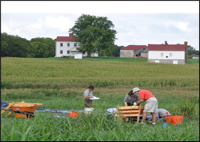
Among the NPS staff sent to the Gulf were three rangers from Monocacy National Battlefield in Frederick, Md. Ben Byrnes, Nathan Hurley and Eric Kelley were sent to Louisiana to assist victims at food distribution points.
Memorial Hall & Beauvoir
The Museum of the Confederacy in Richmond swung into action to help its two sister institutions — Memorial Hall Confederate Museum in New Orleans and Beauvoir, the Biloxi, Miss., home of Jefferson Davis. Davis’s widow, Varina, had divided her husband’s effects among the three places, explained the museum’s executive director, Waite Rawls.
Rawls said the museum was taking up a collection for the staff at Memorial Hall. “They’ve lost so much personally,” he said. Until Sept. 9, 16 people from the hall, including family members of staffers, “were holed up in a motel in Arkansas” with no place to go.
For the first two weeks board member Sam Hood who lives in West Virginia was the primary contact for Memorial Hall news. Early reports were that the museum itself was spared damage and there was likely flooding in the basement.
Reports of looting in New Orleans and incorrect reports that the nearby National D-Day Museum was trashed added to concerns.
At presstime, because there was no mail or courier service, director Pat Ricci had not yet been able to get museum keys to her police officer brother in New Orleans so that he could personally check inside the museum. [A week later this message was received: A member of the staff was able to enter the museum and reported that both the building and the artifacts appear to have escaped storm damage and vandalism/looting. Further detailed inspections of the roof and building will be necessary, but there was no apparent damage.]
The homes of four of the six museum staffers were flooded. Ricci’s was spared.
At Beauvoir, the Jefferson Davis Home and Presidential Library, the house and first floor of the presidential library were extensively damaged. All of the other structures on the property, including director Patrick Hotard’s house, were destroyed.
“We’re working with others to assemble expertise to help them in their salvage,” Rawls said. “Artifacts there got a lot of water damage, and water on textiles and paper needs to be dealt with promptly and correctly.”
Rawls said it was possible that some staffers from the Museum of the Confederacy would travel south to help with the Beauvoir artifacts. “Other people will be able to offer more money than us; we’ve got expertise,” he said.
The museum put a note on its collection box stating that donations would go to Beauvoir and Memorial Hall, and money was flowing into the box at an unaccustomed rate, according to Rawls. Also, by Sept. 9 he said he had received “a dozen checks” from those wishing to help out.
The first newspaper report that Beauvoir was “reduced to rubble” was not accurate, although plenty of rubble was to be seen as the columns, porches and part of the roof were gone.
"The first floor is virtually gone,” said George Malvaney who arrived at the site a day after the storm passed through. An employee of United States Environmental Services, a private firm out of Jackson, Miss., he responded after a U.S. Environmental Protection Agency employee told them the home was in bad shape and needed some "stabilizing."
The crew had not been sent to Biloxi for that particular mission but tried to help save what they could "because it was the right thing to do," said Malvaney.
On their own initiative Malvaney and several co-workers went to the house and found the second floor being held up with only the "brick piers" and virtually nothing remaining of the first floor interior.
"The place was wide open and unguarded with many of the home’s priceless artifacts scattered about the yard," he said. The crew wrapped furniture in plastic and tried to move items into areas of the house that were dry.
Jim Woodrick, Civil War Sites Historian, Mississippi Department of Archives and History, later reported that “a good number of artifacts,” including two recently restored 2nd Mississippi Infantry flags that were on loan, Jefferson Davis’ will and other documents that were put in a vault before the storm survived the storm.
An update at www.beauvoir.org reports that Beauvoir and the Jefferson Davis Presidential Library “will be restored given time and funding.” The Oct. 15-16 annual fall muster weekend at Beauvoir will be a cleanup weekend. Helpers with chainsaws and pickup trucks are needed to work on the 51-acre property. The Mississippi Division of the Sons of Confederate Veterans operates Beauvoir.
Gulf Islands
NPS spokesman Nash pointed to Gulf Islands National Seashore as the hardest-hit of the parks. Early damage estimates there totaled “in the millions,” according to Park Ranger and historian David Ogden.
Several Civil War-era seacoast forts within the park were hit by Katrina, “but they should be relatively OK,” Ogden said. The park comprises 12 units on five islands off the Mississippi coast and two islands off Florida, with the main park unit at Ocean Springs near Biloxi, Miss. It covers 150 miles of coastline and 140,000 acres, although only about 20,000 acres are above water.
Fort Pickens, the park’s most popular site, is located on Santa Rosa Island in the mouth of Pensacola Bay, reached by a bridge from the mainland. The fort was completed in 1834 and was “one of four forts in the South never taken by Confederates,” according to Ogden. Pickens has actually been closed to the public since Hurricane Ivan, Sept. 16, 2004, when the road washed out.
Hurricane Dennis earlier this year aggravated the access problem, and Ogden said aerial photos taken after Katrina showed that a slight breach in the barrier island has now grown to a quarter-mile wide.
“Frankly it’s an open question” when the breach might be closed, the road repaired and Fort Pickens be open again, Ogden said. With all the other demands from damaged parks in the region, “It’s hard to say how much funding we’re going to be able to get.” The park also includes Fort Barrancas, located on the north side of the entrance to Pensacola Bay within the Pensacola Air Station.
Fort Massachusetts, dating from the 1850s, is located on Ship Island 8 miles off Biloxi. The D-shaped structure, with its two tiers of gunports, protected the best deep-water harbor on the Mississippi coast, Ogden said. After Confederates abandoned Ship Island it became headquarters for the Federal blockading squadron in the western gulf and a staging area for Union forces in the 1865 campaign in Mobile Bay.
“I’m sure it got pretty well filled with water,” said Ogden, after viewing aerial photos “The shoreline eroded pretty severely around it. It’s pretty close to the water’s edge. I suspect it has a layer of muck in it and needs to be cleaned out.”
The park unit included a ranger station, snack bar, bathrooms, a half-mile of boardwalk and a dock. Before the storm, excursion boats from Gulfport and New Orleans plied the waters to the island, which boasted “sugar-white sands.”
“The dock is still there and the fort is still there,” Ogden said. “Everything else is marked by pilings.” The dock in Gulfport where the excursion boats took off for Ship Island is also gone.
The park’s own headquarters at Ocean Springs was flooded with several feet of water and “will have to be gutted,” Ogden said. Several park employees lost their homes, and others’ homes were flooded.
“We’re not even making any sort of predictions” when repairs may be effected, Ogden said. “The situation in the Mississippi District is so disastrous.”
On Sept. 13 the NPS reported that the earthen berm on top of Fort Massachusetts was eroded and some large granite blocks had fallen into the moat. The fort was filled with mud and debris several inches thick.
Dry Tortugas
Dry Tortugas National Park, “America’s most inaccessible national park,” is a cluster of islands in the Florida Straits 70 miles west of Key West. Fort Jefferson, at 11 acres in size the largest coastal fort in the U.S., was built on 16-acre Garden Key beginning in 1846 to protect shipping lanes in the Gulf. The fort served as a Union prison camp during the war, and housed among others Dr. Samuel Mudd, who assisted the injured John Wilkes Booth following the assassination of President Abraham Lincoln.
Park employee Mike Ryan, reached by e-mail after the park’s 70-foot communications tower was destroyed, wrote, “The fury of the storm, with sustained winds estimated as high as 105 mph, lasted throughout much of Friday, Aug. 26.” The eye of Katrina passed within 30 miles of the fort.
Ryan called damage to the park “extensive,” including felled trees and damaged docks. “Flooding inside the fort occurred due to heavy rains; many of the quarters and office spaces had large amounts of standing water.”
Damage to the structure was “not significant,” however, Ryan wrote. “The fort’s massive, 8-foot-thick masonry walls, combined with the surrounding coral reefs (which form an underwater protective barrier during storms), help[ed] to reduce the catastrophic types of damage that have recently been seen on the Gulf Coast.”
The NPS later reported that the park opened on Sept. 10 and its campground, which had not been damaged, was available for public use. A contract was to be issued to dredge the moat around the fort and generators were on the way.
Vicksburg
At Vicksburg National Military Park in Mississippi, high winds and heavy rain combined to fell “quite a few trees,” according to Superintendent Monica Mayr, forcing closure of the park from noon on Monday, Aug. 29, to a partial re-opening at 3 p.m. the following day.
A tree broke through a roof, shingles were ripped off the cemetery maintenance shop, and the canopy shielding the USS Cairo exhibit was ripped “in a couple of places,” Mayr said, although the vessel was not damaged. The canopy is under warranty and the company has been notified.
Mayr had no estimate for damages at presstime. She noted that the park offered to take National Park Service evacuees from the storm-struck region, who would be housed in an available park building. Also, the park’s chief of operations, Rick Martin, a lieutenant colonel in the National Guard, was deployed Sept. 3, to Gulfport, Miss., and “we don’t know when we’ll see him again.”
Natchez Trace
At Natchez Trace Parkway in Alabama, Mississippi and Tennessee, “thousands” of downed trees forced a two-and-a-half-day closure of 200 miles of the highway, according to Chief Ranger Charles Cuvelier.
The parkway, dating from the 1780s, stretches 444 miles from Natchez, Miss., to Nashville, Tenn. At Locust Historic Site, just outside Natchez, a tree limb damaged the roof of the oldest building in Mississippi and large oak trees toppled. Cleanup would take months, Cuvelier predicted.
Natchez Trace also administers Tupelo National Battlefield in Tupelo and Brice’s Crossroads National Battlefield north of Tupelo. With no visitor centers at either, Cuvelier said, there was “very minimal damage.”
As for the parkway, Cuvelier said, after all the downed trees “It will look a little unkempt, I guess.” He said people were concerned that its beauty was permanently marred. In 1994, however, the parkway was hit by an ice storm “and people thought the park would never regain its character, but it did. Natural beauty will restore itself.”
Cuvelier said no estimate had been made of the damage. The challenge for the park, he said, was to obtain outside contractors to undertake the cleanup when such crews were in great demand throughout the region on account of the hurricane.
Shiloh
At Shiloh National Military Park in Tennessee, Superintendent Woody Harrell declared, “We dodged the bullet.”
“By the time it got to Tupelo, the force just went out of it,” said Harrell. “It came pretty much straight over us.”
Damage was confined to a few downed trees and power lines, “and it didn’t take us long to clean it up.” More than 4 inches of rain fell in 36 hours, but since the summer had been “pretty dry, we could take all we could get.”
The storm felled trees and caused other problems at the park’s Corinth unit, 23 miles to the southwest, which sustained telephone and computer outages. There were no park closures, however.
Louisiana Parks
The State of Louisiana has two battlefield parks, which sustained “virtually no” damage, according to a spokesman for the state parks department. Port Hudson State Historic Site is about 20 miles north of Baton Rouge, while the 177-acre state park that comprises Mansfield Battlefield is south of Shreveport.
Mississippi Parks
In Mississippi, the state owns and administers the Champion Hill and Port Gibson battlefield parks. “We were very fortunate,” said Jim Barnett, director of historic properties for the Mississippi Department of Archives and History. The properties were in the western portion of the state, which was more lightly touched.
At Champion Hill, an 825-acre site 17 miles west of Jackson, the historic Coker House sustained no damage from the storm. The long-neglected building, a witness of intense fighting on May 16, 1863, is about to undergo a $1 million restoration project.
Barnett said at Champion Hill “we only had a few limbs, a few trees blown down. The effect was negligible.”
At Port Gibson, south of Vicksburg, the historic Shaifer House and 12 acres owned by the state also escaped damage. The first clash as Federal forces under U.S. Grant began their march upon Vicksburg occurred on May 1, 1863, in the yard of the early-1800s farmhouse, which is open to the public.
The state also owns 28 acres of the Big Black River battlefield, between Jackson and Vicksburg, but there was no damage to the wooded bottomland.
Alabama Parks
Alabama owns Fort Morgan, at the entrance to Mobile Bay. Elizabeth Brown, acting director of the Alabama Historical Commission, said the fort sustained “considerably less damage than last year,” when Hurricane Ivan forced bay water into the fort and damaged the roof. Costs totaled about a quarter of a million dollars, including damage to the ferry landing.
This time several shingles were lost and the ferry landing filled with sand. Since the insurance settlement was just received to fix the fort’s roof, damage from Katrina will be repaired at the same time. The fort has about 100,000 to 125,000 visitors a year, according to Brown.
Relief Funds
Donations for Beauvoir relief may be sent to Ward Calhoun, P.O. Box 1786, Meridian, MS 39302. To donate equipment and supplies contact Rick Forte at (601) 268-3323.
Donations for Memorial Hall Confederate Museum should be sent to the Memorial Hall Museum Relief Fund, Suite 180, Box 278, 6658 Youree Dr., Shreveport LA 71105.
The Employees and Alumni Association of the National Park Service is accepting donations to assist employees from Gulf Islands National Seashore, Jean LaFitte National Historic Park and New Orleans Jazz National Historic Park who lost homes or possessions. Donations payable to Employees and Alumni Association may be sent to E&AA, Hurricane Katrina Relief Fund, 470 Maryland Dr., Suite 1, Fort Washington, PA 19034.
The National Trust for Historic Preservation set up a “2005 Hurricane Relief Fund” in the days following the storm.
“We were hesitant to set it up” when the human needs were so great, said National Trust spokesman Jeannie McPherson, “but we want to be sure that the cultural heritage of New Orleans and other places on the Gulf Coast is preserved. So often the thought is, ‘Let’s go in and knock it down and rebuild.’”
The fund will help pay for damage-assessment teams being fielded by the National Trust. McPherson said that within two weeks of the storm the organization had recruited more than 500 volunteers to travel to historic sites, both public and private, in the affected region and survey them for damage.
The assessments will be used to help seek congressional funding for preservation, and to help lobby for support, McPherson said. Information on the relief fund and volunteer opportunities is available at www.nationaltrust.org.
The Sons of Confederate Veterans has a relief fund established last year. Tax-deductible donations may be sent to the SCV, P.O. Box 59, Columbia TN 38402-0059.
Donations to help restoration of Mississippi historic sites and artifacts may be sent payable to the Foundation for Mississippi History, P.O. Box 571, Jackson, MS 39205-0571.
Gregory L. Wade and Kathryn Jorgensen contributed to this report.