
Jefferson Barracks PX Building Is Future Home Of Missouri Civil War Museum
By Kelly Garbus
April 2005
ST. LOUIS, Mo. - It's a run-down, century-old building
that has been living on borrowed time. Boarded up for nearly 50
years, rain had poured through the roof and 150,000 bees living
inside were said to sound like the drone of a jet engine.
But to Mark Trout, 41, and Jim Hubbard, 46, the 1905 Jefferson
Barracks Post Exchange and Gymnasium building in St. Louis County has
the potential to become a premier Missouri Civil War museum. All it
would need is some tender loving care, fund-raising and corporate
sponsorship - about $1.5 million worth.
The idea for a Missouri Civil War museum and educational center
originated during discussion among members of the Ulysses S. Grant
Camp #68, Sons of Union Veterans, of which Trout and Hubbard are
members.
It was mostly just talk at first. But then Trout, who is a former
Kansas City, Mo., police officer, came across the boarded-up building
while visiting Jefferson Barracks, a national historic site on the
Mississippi River north of Interstate 64 in St. Louis.
Jefferson Barracks was founded in 1826, and named in honor of
President Thomas Jefferson who died that same year. The military
installation once served as the country's first Infantry School of
Practice.
In 1903 government blueprints called for a Post Exchange to be
constructed at Jefferson Barracks. It would include a gymnasium, a
barbershop, an indoor pistol range and a two-lane bowling alley for
commissioned officers. It also would have a kitchen area, recreation
rooms and a locker room.
The building was abandoned in 1953, but not before its incarnations
as a barracks in the 1920s and an entertainment center for troops in
the 1930s.
Trout wasted no time in initiating discussions with government
officials to obtain the old Post Exchange, and a 99-year lease was
negotiated on the property, which is managed by the county and owned
by the state. Other buildings at the barracks are open to visitors.
A nonprofit Missouri Civil War Museum organization was founded in
2003 and opened up for membership to help raise funds.
Trout, who works for the Department of Planning and Parks for a St.
Louis County city, serves as chairman of the nonprofit. Hubbard, an
inventory resource supervisor for a hospital, is vice chairman. The
grassroots effort has grown to 175 members in 23 states, says Trout.
"This has never been done before in Missouri," he says.
According to brochures, organizers hope to build "Missouri's largest
and finest educational facility exclusively dedicated to the study of
the American Civil War and its relevance to the State of Missouri."
Plans call for display galleries, meeting rooms, a theater for video
and media presentations, a gift shop, a dining facility and a large
reference library.
Trout describes Jefferson Barracks as the "right location," given its
Civil War connections. About 220 Civil War generals, earlier in their
careers, saw duty at Jefferson Barracks, including Ulysses S. Grant
and Robert E. Lee. In addition, a nearby national cemetery contains
some 12,000 Union and 1,140 Confederate veterans, according to a
promotional brochure.
Trout says the museum is currently accepting donated relics as well
as reproduced items. Realistically though, he says the museum would
never be able to offer holdings on par with facilities in the East
that have thousands of original artifacts. "We hope to work with
other institutions on loan programs, but we are relying on a lot of
reproduced items," he says.
The organization is also in the process of receiving and processing
family letters and other Civil War documents. The goal is to compile
a database of military records, including muster rolls, pensions,
diaries, photos and records of Missouri troops. The organizers say
they envision high school and college students, authors and scholars
using the library and database.
But building restoration gets top billing for now. The Post Exchange
is a 15,000-square-foot-facility. The modified Federal- style
architecture includes a tile roof and 100 windows.
"I can't tell you the thousands of hours that people have spent
working on this building," says Trout. "We have about a dozen which
are the heart and soul of our work day program which we call the
Dream Team." They are volunteers who meet every Saturday to work on
the project and have hauled enough debris out of the building to fill
15 large construction dumpsters.
Then there was the honey. An exterminator removed the bees and
advised getting rid of the honey or the insects would return. "There
were so many of them that we could not work on the gymnasium portion
of the building," Hubbard says. The beehives and honey cleanup filled
four 55-gallon trash cans.
"It was, in a word, nasty," he says.
The organizers have a 10-year plan that includes spending the next
three to four years on major restoration and fund-raising. They hope
to open the museum by 2007.
This year, Trout says, they will be busy seeking major corporate
sponsors to help underwrite expenses. In addition, the search is
ongoing for grants to help fund restoration. Trout also hopes to
boost membership in the organization and garner the support of the
reenactment community.
So far the Missouri Civil War Museum group has been operating on a
pay-as-you go basis. "We raise $1,000, we spend it. We raise $10,000,
we spend it," Trout says. To date about $75,000 has been spent in
labor and materials on the building. The largest donation was $15,000
from the Missouri Veterans Commission.
The cost of restoration is not cheap. A 22-foot section of soffit -
the underside of the outside eaves -- was replaced at a cost of
$6,000. That leaves 476 more feet to go.
Hubbard says a carpenter who inspected the building advised them to
immediately replace a 23-foot long, 12-inch-square beam. "It was the
main support beam for the two sections of the roof," he says. "The
carpenter told us if that had given way those masonry walls would
have crumbled like a stack of dominoes."
"It's definitely a labor of love," says Hubbard, who spends much of
his free time working on the project. He adds he is fortunate to have
such an understanding wife.
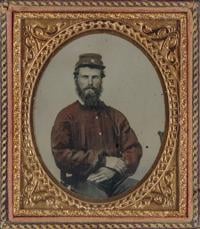
Trout and Hubbard had ancestors who fought in the Civil War. Hubbard
had a great-great-grandfather with the 24th Indiana Infantry who
spent several months fighting guerillas in Missouri. Trout had
great-great-grandfathers on both sides of the war who fought against
one another at the Battle of Westport, Mo.
"They are my motivation," he says.
For more information visit www.missouricivilwarmuseum.org. |