
Study To Address Glorieta Battlefield Safety Concerns
By Deborah Fitts
April 2004 GLORIETA, N.M.
A federal appropriation of $373,000 to
study highway safety at Glorieta Pass could prove a major step toward
opening the battlefield to regular public access for the first time.
In 1990 Congress added the battlefield, comprising two 350-acre
units, to Pecos National Historical Park. But the park restricts
visitation on account of New Mexico Road 50, a two-lane highway that
runs through the middle of the Pigeon's Ranch unit, scene of the
heaviest fighting on March 28, 1862.
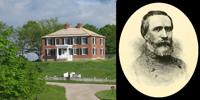
In fact, an adobe building that is the only surviving structure from
the battle sits 3 feet from the edge of the road. Today's N.M. 50, a
busy commuter artery from Pecos to Santa Fe, overlies the historic
Santa Fe Trail, which once brought patrons to the stage stop run by
Frenchman Alexandre "Pigeon" Valle.
"When it snows, the plows just throw the snow against the building,"
said Randall Rasmussen, coordinator of the Glorieta Battlefield
Coalition. The former stage stop is boarded up and a metal guardrail
runs between it and the road. The highway is posted at 45 mph but
"People go a lot faster."
"It's a sad testament to a site that's hallowed ground here," Rasmussen said.
Last year the Civil War Preservation Trust named Glorieta among the
10 most threatened battlefields in the country, citing the
overwhelming impact of N.M. 50.
A proposal by the New Mexico transportation department more than a
decade ago to widen the highway and demolish the building prompted
supporters of the battlefield to rally on its behalf. The Coalition,
a grassroots group of about two dozen historians, conservationists,
local government officials and others, spearheaded the effort to
secure the federal funding.
"These are folks who feel deeply that Glorieta's history needs to be
observed," Rasmussen said. "The battle was a unique chapter of the
Civil War in the West and needs to be told to a larger audience.
We're dedicated to seeing that the history of the West's only Civil
War battlefield park is properly showcased."
Dennis Ditmanson, superintendent of Pecos National Historical Park,
said at presstime in March that the actual amount that will be
available for the study was uncertain, nor was he sure who would
actually conduct the study. But the study is expected to explore a
range of options, including modifying the road in place, restricting
truck traffic, or even building a new road away from the battlefield
to shunt commuter traffic onto nearby Interstate 25.
Glorieta "is a very unique setting and a major battlefield of the
Civil War," Ditmanson said. "It has the potential to be a real
attraction for people with Civil War interest in this part of the
country." At present the park gives guided tours of the battlefield
but there is no regular access and no parking.
Ditmanson noted that the Coalition spearheaded the effort to get the
federal funding. "We appreciate their effort," he said. "It's a way
of getting the process moving forward."
He added, however, that any solution is years away. "We're going to
have to work with the road where it is, at least in the short term."
Meanwhile, Ditmanson said he expects to develop an interpretive plan
for the battlefield by this fall.
Still, the park is handicapped, he noted, by funding and staffing
restraints; there is "no specific money" set aside for the
battlefield in the park budget.
Coalition member Pat Nagle said the traffic study should seek not
just to improve battlefield access, but ensure that "anyone who lives
in the area has their needs met."
But Nagle cautioned that any expansion of N.M. 50 "would be a threat
to the battlefield." And she noted that an NPS study several years
ago found that the three-room ranch building is suffering from
vibrations caused by the adjacent traffic.
Pigeon's Ranch originally comprised a large complex of buildings, but
today only the three-room structure survives. Other battlefield
features include the ruins of a stone-walled corral, behind which
troops fought, and Sharpshooters Ridge, a large stone outcrop
overlooking the ranch that served as a Union defensive position.
The two-day battle, often dubbed "the Gettysburg of the West," pitted
about 1,300 Confederates from Texas against a similar number of Union
troops from Colorado and New Mexico. The first day's fighting, March
26, 1862, took place on the west side of Glorieta Pass, which is
located at the southernmost tip of the Rocky Mountains. That fighting
is represented by the park's CaÒoncito unit.
A day of recuperation was followed by the battle's hottest fighting,
on the 28th, at Pigeon's Ranch on the east side of the pass.
Confederates gained the upper hand but a flanking movement over
Glorieta Mesa by a Federal party resulted in destruction of the
Confederate supply wagons and forced the Texans to retreat to Santa
Fe and eventually to Texas.
The ranch building was used as a hospital by both sides. According to
Nagle, Pigeon was ruined by the war. Afterwards he put in for damages
against the federal government, asserting that he had lost everything.
Nagle, who was born and raised in New Mexico, has written two novels
of the Civil War, including Glorieta Pass, published in 1999.
"This is a wonderful place of our history," she said. "The
battlefield should be accessible to anyone interested in seeing what
the war was like out in the far West. The numbers of men were small
but the stakes were very high."
The money for the traffic study was included in a federal omnibus
spending bill signed by President Bush on Jan. 23. The Coalition had
originally sought $750,000, but Congress reduced the request.
Supporters of the funding included the New Mexico legislature, the
Village of Pecos, the Santa Fe County Commission and Gov. Bill
Richardson.
The two Glorieta battlefield units lie about 10 miles distant from
the rest of Pecos National Historical Park. The main unit comprises
5,500 acres and attracts from 35,000 to 40,000 visitors annually.