Gettysburg Museum Drive
By Deborah
Fitts
GETTYSBURG, Pa.
A man with a national reputation in
the museum community has been chosen to lead the effort to build the $39 million
new visitor center and museum at Gettysburg National Military Park.
Robert
C. Wilburn, who until recently served as president of the Colonial Williamsburg
Foundation, was named president Oct. 24 of the nonprofit Gettysburg National Battlefield
Museum Foundation.
"This is an opportunity to tell the story of the Civil War
and Gettysburg in an exciting and inspirational manner," said Wilburn, 57, a Pennsylvania
native.
"I have long been involved in the preservation of collections and historic
sites, and this is one that's terribly important."
Wilburn was chosen by Robert
A. Kinsley, chairman of the foundation. Chief of Kinsley Construction in York,
Pa., Kinsley was selected in a competition mounted by the National Park Service
to find a private partner to build the new facility. The foundation signed a binding
agreement with the park June 30 to proceed with the project.
Barbara Sardella,
general counsel for the museum foundation, said an executive search firm was employed
"that dealt almost exclusively in the nonprofit area. Bob's [Wilburn] name was
on top of the heap."
Wilburn cited Kinsley's enthusiasm for the project as
one reason that he took the job. Kinsley "wants this to be first-class," Wilburn
said.
Wilburn, who regards himself as "more of a history buff" than an expert
on the Civil War, will be charged both with raising the money to build the complex
and with planning the building and exhibits. He will operate out of an office
in Washington with the help of a director of development and two staffers.
Sardella
said the small staff was designed to meet an NPS requirement that administrative
expenses not exceed 20 percent of total fundraising. "We'll stay under that,"
she said. She declined to state Wilburn's salary, saying only that it was "commensurate"
with his salary at Colonial Williamsburg.
The Washington location
is best for "what [Wilburn] needs to accomplish," said Sardella, citing "a lot"
of cross-country travel. "And it's close enough to get to Gettysburg quickly."
Wilburn
said he would complete a fundraising plan "within the next couple of months" and
actually begin fundraising after the start of the new year. He will select architects
and exhibit designers, and will seek input from community leaders, historians
and others through a series of public sessions.
The foundation's
goal is, within two years, to raise $27.4 million in private donations and another
$11.9 million in commercial financing. Construction is expected to take another
two years, with opening likely four to five years from now.
Wilburn
predicted that more of the private funding will come from individuals than corporations.
"I've got to believe the dollars will follow the vision," he said. "It will be
a matter of communicating to the public the potential impact a place like this
has on citizens of all ages."
Kinsley noted that Wilburn has
served as CEO for a variety of institutions. He headed Colonial Williamsburg for
seven years, reversing a decline in attendance and income with interactive programs,
live broadcasts to classrooms nationwide, teacher training, and dramatically increased
support from donors.
Prior to his stint at Williamsburg Wilburn
served as president and CEO of the Carnegie Institute for eight years, overseeing
its merger with another institution to build the $40 million Carnegie Science
Center. He also founded the Andy Warhol Museum in Pittsburgh, leading a $125 million
campaign.
He earlier served for six years as a cabinet member
in the administration of former Pennsylvania Gov. Richard Thornburgh, first as
head of budget and then as education secretary. He was an economist and policy
analyst with the Defense Department and the White House in the late 1960s and
early •70s.
Wilburn received a bachelor's degree in economics
and engineering from the Air Force Academy and his master's and Ph.D. degrees
in economics and public affairs from Princeton. He is chairman of the U.S. committee
of the International Commission on Monuments and historic Sites (ICOMOS), an international
organization of professionals dedicated to saving the world's historic monuments
and places. He and his wife, who have four children, make their home base an 1840s
farmhouse near Pittsburgh.
Wilburn cited a "shared vision"
with the National Park Service: "educational programs that excite and inspire,
and facilities that meet the expectations of today's visitors and can accommodate
increased numbers of visitors who, with enhanced programs and facilities, will
stay here longer and return more frequently."
Kinsley said
that in his different positions, Wilburn has consistently "rekindled a new sense
of purpose and generated excitement and vision of new possibilities." He has also
"sharply" boosted the number of visitors, volunteers, members and donors.
Wilburn
is expected to stay on as head of the foundation through the construction of the
new complex. At presstime the foundation board consisted only of Kinsley, as president;
Sardella, treasurer; and Dan Driver, chief financial officer of Kinsley Construction.
Only Kinsley will likely remain on the permanent board, which Sardella predicted
will be assembled in three to six months.
"We've been quietly
talking to people" who are likely candidates, she said. Criteria include "kind
of a passion" for the Civil War and Gettysburg, plus "an interest in raising money."
The foundation does have a museum advisory committee, consisting of six historians
and two individuals from the museum community. The historians are James McPherson
of Princeton; Eric Foner, Columbia University; Nina Silber, Boston University;
Gary Gallagher, University of Virginia; Gabor Boritt, Gettysburg College; and
NPS Chief Historian Dwight Pitcaithley. The museum officials are Robin Reed, director
of the Museum of the Confederacy; and Olivia Mahoney, director of historical documentation
at the Chicago Historical Society.
Wilburn's salary, at least
initially, is being paid by Kinsley through his philanthropic Kinsley Family Foundation.
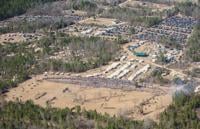
To date, Kinsley has donated more than $4 million to the project, the bulk of
it to purchase the 45-acre property off the Baltimore Pike and Hunt Avenue where
the visitor center and museum will be built. Kinsley has also paid for feasibility
studies and other expenses. Sardella said the $4 million comprises an outright
donation to the project, noting that Kinsley will not seek to recoup the money
in the course of the foundation's fundraising.