Civil War News For People With An Active Interest in the Civil War Today

Georgia Couple Tries To Protect 1864 Confederate Fort
By Deborah Fitts
January 2005

ROME, Ga. - A preservation group so small as to seem quixotic is attempting to protect a little-known Confederate fort from encroachment by the Georgia Department of Transportation.

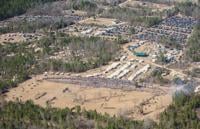
David Fowler Jr. and his wife Cailey incorporated the Fort Attaway Preservation Society in 2002 and are the sole members. The Fowlers' home and 10-acre property includes about half of a 2-acre hilltop area with the remnants of Fort Attaway, a collection of gun emplacements and trenches strung along a ridge.

"It's Rome's only Civil War fort that was actually used" in battle, declares Fowler, referring to a clash on May 17, 1864. "It happens to be my backyard. If we don't do something, who will?"

State transportation officials want to widen Route 27. The four-lane road runs along the foot of DeSoto Hill, where the fort is sited north of the city. The state also wants to relocate about 2,000 feet of the Norfolk Southern Railroad, which passes over the highway on a trestle bridge at the northern tip of the hill. The project calls for building a new bridge about 30 feet farther up the hillside - which will destroy part of the fort, according to Fowler.

The improvement project, on the books for years, seeks to remedy traffic backups caused by a narrowing of the roadway under the bridge. Also, the trestle is too low to accommodate some trucks and buses.

Fowler, 41, a former champion rodeo rider who makes a living installing utility poles, has acknowledged that his interest in the Civil War was sparked when he realized that the existence of the fort could help protect his wooded property on DeSoto Hill from encroachment. "I'm just an old country boy with this thing in my backyard," he says. But he has been a dedicated convert to the preservation cause.

Fowler says he has spent $18,000 to date on historical studies and lawyers' fees, and claims that the effort has stalled the Georgia Department of Transportation "for three solid years." Still, the state hasn't changed its plans, he says.

"They're the big highway department, and they can just run over my butt."

The Fowlers commissioned U.S. Army historian David Chuber, an authority on Civil War earthworks, to study and research the fort. In his 10-page report, Chuber found "a complex of infantry entrenchments and gun positions" which have been partially destroyed by "urban encroachment." He also cited campsites, fire rings, and a number of relics found on the hill, including buttons from Texas and North Carolina uniforms, stirrups and horseshoes.

Fowler forwarded Chuber's findings to the Federal Highway Administration (FHA) and Georgia transportation officials. He also enclosed a statement from Mark Snell, director of the George Tyler Moore Center for the Study of the Civil War at Shepherd University in Shepherdstown, W.Va., in which Snell pointed to the trenches and artillery positions as "sound evidence" of the presence of the fort.

Snell wrote that "any encroachment onto DeSoto Hill would destroy any existing cultural artifacts and undoubtedly would violate the historic boundary of Fort Attaway." Besides the Fowlers, a Japanese restaurant occupies part of the fort.

The Fowlers' attorney, Jonathan Schwartz, says they are proposing to highway officials that the railroad bridge be rebuilt on the same footprint. The state's reason for relocating the trestle is to keep the tracks open while the new bridge is being built, but Schwartz contends that the bridge could be built off-site and "rolled in" to place in a day or two.

Schwartz says the FHA, which is involved because the project is using federal funds, failed to comply with the National Historic Preservation Act. The project has been approved by the historic preservation division of the Georgia Department of Natural Resources.

"Our contention is that because it's a historic site, they have an obligation to avoid or minimize impacts to the resource," Schwartz says. He argues that if the state can't build the bridge in place, they should move it in the other direction, away from the fort, despite an impact on existing businesses.

"They'd always rather go through vacant property, but they can't do it here unless there's no feasible and prudent alternative."

According to Fowler, the railroad was built in 1890 onto the bottom terrace of the fort near the foot of the hill. He maintains that there are trenches immediately adjacent to the tracks that would be destroyed by the relocation. Meanwhile, Fowler acknowledges that Fort Attaway "was never a perfect fort," but a series of gun emplacements and trenches amid. rocky outcroppings He also admits that many in Rome are eager for the road improvements, but says he has obtained hundreds of signatures and the support of the American Legion in Rome.

The chairman of the Georgia Civil War Commission, Dan Childs, visited the site last year. Childs said, however, that the commission "never took a strong stance." The commission has practically ceased operations since losing its funding (see related story), but Childs says, "We were interested and concerned about the presence of those earthworks."

The federal Advisory Council on Historic Preservation has "sent correspondence questioning whether the preservation act was complied with," and the National Trust for Historic Preservation "has shown some interest."

The Georgia transportation department has twice delayed going out to bid on the project, but Schwartz says it's unclear whether the Fowlers' objections were the reason.

"I think they have a very good case," he says. "I'm hoping we can resolve it without filing a lawsuit."

Rome has two other Civil War forts, Stovall and Jackson, but Fowler contends that only Attaway actually was involved in fighting.

"Fort Attaway is kind of the icing on the cake." He says he hopes that sometime a protected Fort Attaway may be available for tourists to visit, and that local tourism officials will help promote it.

"I don't understand how they can have a Civil War future in Rome without Fort Attaway as a part of it," Fowler says.

Historical Publications Inc. 234 Monarch Hill Rd. Tunbridge VT 05077

Our email address is: mail@civilwarnews.com

Subscriptions: (800) 777-1862 Free Sample: (800) 777-1862 Display Ads: (800) 777-1862 Editorial: (802) 889-3500 Fax: (802) 889-5627