Civil War News
For People With An Active Interest in the Civil War Today

Rediscovered Memoir Adds to Urgency of Effort to Save Battle-Scarred House

By Joe Kirby

January 2006

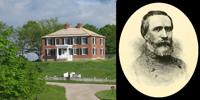
MARIETTA, Ga. — Plans are afoot to save the last remaining house outside of Kennesaw Mountain National Battlefield Park known to have suffered damage as part of that Civil War clash. And due to an August story about the house in the local Marietta Daily Journal, a memoir about the battle, including a Union friendly fire incident, has come to light. The document was dictated late in life by the daughter of the farmhouse’s owner.


The Dickson House (referred to on wartime maps as the "Dixon" House) was built in 1855 by farmer David Dickson along Sandtown Road, a former Indian road that was a major thoroughfare just west of Kennesaw Mountain at the time of the battle. It is known today as Acworth-Due West Road.


A short, sharp fight along that road is known as the Battle of Gilgal Church.


Despite bearing the scars of war, the old house, which is still in good condition and was used in the 1990s as a church, is slated for demolition to make way for a five-house subdivision planned by Secor Development.


Cobb Commission Chairman Sam Olens had put a temporary hold on the demolition after retired Kennesaw State University history professor (and former Cobb Commission Chairman) Dr. Phil Secrist brought the history of the house to Olens’ attention.


Now Secrist is heading an effort to buy the subdivision lot that contains the house and then have the structure added to the National Register of Historic Places.


"That’s the best plan for having it added to the Register — leave it where it is," he said, explaining that removing a historic structure from its context undermines its integrity.


Secrist envisions putting up a historic marker and adding a few parking places and using the house for educational purposes.


Secrist said the cost of the lot is likely in the $60,000 to $80,000 range and that several persons have expressed interest in helping meet the price. The developer has offered to give the house to anyone who would move it and help with the costs, he said.


"The developer has been very cooperative and is interested in assisting us in our preservation efforts," added Cobb director of community development director Rob Hosack. Before Thanksgiving approximately 30 days were left on the previously agreed upon hold. “If we needed an additional week or two, the developer would be likely to grant such an extension," he said.


If the effort to buy the lot falls short, the fallback option would be to move the house onto the grounds of the nearby Gilgal Church battlefield park, which is maintained by a trust administered by the Atlanta History Center.


The county has shown little interest in acquiring the property, but has said it would help move the house.


Publication of the August newspaper story about the house’s predicament led two Cobb County descendants of Dickson to contact Secrist. One, Carl Abbott, produced a copy of the unpublished "Memory of the Confederate War," a memoir by Dickson’s daughter Eliza Dickson Helton. She was 14 at the time of the 1864 battle and dictated her story in November 1935 the year before her death.


She said that as Northern troops approached the house and the nearby strategic intersection of Sandtown, Burnt Hickory and Due West roads, Union artillerists in the distance mistook several Union infantrymen in the veranda of the house for Rebels.


"The Northern soldiers seeing them supposed they were Confederate soldiers and turned the cannon on them, the ball killing five and wounding one. Six graves were made in the garden. They had killed their own men. … These soldiers fell dead in the hall," she dictated. Their bodies were moved after the war to the National Cemetery in Marietta, but the stains from their blood remain on the floorboards.


Breastworks for a four-gun Union artillery position are still visible on a nearby hill along Acworth-Due West. Lending further credence to Helton’s memories is the fact that four shell-damaged floor joists can still be seen beneath the one-story house, Dr. Secrist said.
The house’s hand-hewn log walls are believed to still bear bullet holes as well. The house was remodeled in the 1920s in the then-popular Craftsman style, which is part of the reason that county zoning officials had overlooked its historic nature.


The Battle of Gilgal Church that took place on June 15, 1864, was one of a number of small battles fought in Cobb in the weeks prior to the Battle of Kennesaw Mountain as the Confederate army was forced back toward Marietta. It took place when a division of Union Gen. William T. Sherman’s army pushing down Sandtown (Acworth-Due West) Road collided with a Confederate division under Gen. Patrick Cleburne stationed along a ridge just south of Due West Road.


As the Federals approached, Cleburne’s men hurried to Gilgal Church, which stood at the strategic intersection, and completely dismantled it in order to incorporate the wood and pews in their fortifications.


The Union troops attacked and were quickly repulsed with the loss of about 200 men. Cleburne’s casualties were negligible. Gen. Joe Hooker, one of Sherman’s corps commanders, used the Dickson House as a headquarters during the brief battle, according to the Official Records of the War of Rebellion.


"I hope when the dust clears we don’t wind up making some of the same mistakes we’ve made that have cost us some of our other historic houses in Cobb," said Dr. Secrist.

Historical Publications Inc.
234 Monarch Hill Rd.
Tunbridge VT 05077

Our email address is: mail@civilwarnews.com

Subscriptions: (800) 777-1862
Free Sample: (800) 777-1862
Display Ads: (800) 777-1862
Editorial: (802) 889-3500
Fax: (802) 889-5627