
Huge Development Proposed At Chancellorsville
By Deborah Fitts –
August 2002
FREDERICKSBURG, Va. — A "new city"
with thousands of homes and acres of commercial development
is being proposed at Chancellorsville battlefield.
"I don't think there's ever been a project in the park's
history that presents such a threat all in one chunk,"
said John Hennessy, acting superintendent at Fredericksburg
& Spotsylvania National Military Park. "No matter where
you are in the park there will be an impact. It will be disastrous."
The proposal, by Reston, Va.,-based Dogwood Development Group,
calls for 2350 homes and 2 million to 3 mil-lion square feet
of office and retail space, generating 70,000 vehicle trips
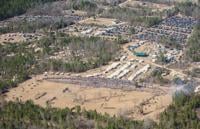
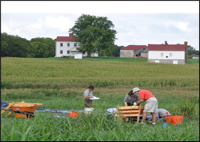
a day. The 771-acre tract, currently rolling farmland, is located
60 yards across Route 3 from McLaws Drive and the park's Chancellorsville
unit.
Dogwood filed an application June 21 asking Spotsylvania County
for a rezoning of the property to allow the pro-ject. Dogwood
President Ray Smith Jr. envisioned the development, to be called
"Chancellorsville," as "a real town," with
homes, 7000 jobs, and as many as 15 restaurants, generating
$11 million annually in net benefit to the county.
The projected new vehicle trips will nearly triple the current
flow. Ninety-five percent of park visitors will "pass through
this new city" on their way to the battlefield, Hennessy
said, dramatically altering their appreciation of one of the
most significant battles of the Civil War.
He warned that the development would inevitably lead to calls
for widening Route 3's present four lanes, to six or eight.
"We are not yielding land to expand roads that will rip
out the heart of the park," Hennessy vowed.
The Dogwood tract, with a mile of frontage on the highway, comprises
virtually all of what remains of the first day's battlefield
at Chancellorsville, according to Hennessy. The park boundary
includes land fought over on May 2 and 3, 1863, but none from
May 1.
Dogwood is proposing to set aside 34 acres for "Battlefield
Park," plus land along Route 3 for a buffer. But Hennessy
said the measure "doesn't begin to address the impact on
the park" by the development.
Jim Campi, spokesman for the Washington-based Civil War Preservation
Trust, called the 34-acre offer "ludicrous."
The May 1 battleground comprises 300 to 400 acres on Dogwood's
property, he said, not including a protective viewshed. Meanwhile,
the impact on the neighboring federal park, where visitors are
already endangered by passing traffic when they stop at interpretive
waysides, may be such that no one will want to come any more,
Campi warned. The Dogwood project, as envisioned, would sound
the park's "death knell," he said.
Campi said the Trust would prefer to work with Dogwood in a
deal similar to Bristoe Station, where a developer recently
agreed to preserve a significant portion of the battlefield
in return for the Trust's support for residential development.
But if no such deal is possible, "We're going for broke"
and opposing Dogwood all the way, Campi said.
He said the Trust would work to form a coalition of national
and local groups "to fight this and come up with concrete
solutions." "Most of the county looks at Chancellorsville
as a local issue," Campi said. "It's not. It's a national
issue. It's one of the most significant Civil War battlefields
and it needs to be considered that way."
The proposal raised anew the specter of a proposed Fredericksburg
bypass, the Outer Connector, which battlefield supporters fear
will harm the park's setting.
Also joining the fray was the Washington-based National Trust
for Historic Preservation, which in 1998 named Chancellorsville
one of the country's 11 most endangered historic sites.
In early July, National Trust President Richard Moe noted the
significance of the Confederate victory at Chancellorsville,
where Confederate commanders Robert E. Lee and Stonewall Jackson
devised a brilliant flank march that caught the Federals by
surprise. The triumph was clouded by the mortal wounding of
Jackson as he reconnoitered for advantage at dusk just hours
after his assault.
"Chancellorsville encompassed some of the boldest strategy
of the Civil War and resulted in more than 30,000 casualties,"
Moe said. "This so-called new historic town and the fledgling
Outer Connector superhighway only add to the unchecked sprawl
in that area and could very well pave over much of this historic
national landmark where a chapter of America's story was written."
Hap Connors, spokesman for the National Trust, blamed pro-development
government for the region's unchecked growth. "That whole
area is a poster child for bad development, bad government,
bad planning and greed," said Connors, "all of which
adds up to dumb growth."
Meanwhile, the Fredericksburg-based Central Virginia Battlefields
Trust (CVBT) is weighing in with a preservation proposal. Mike
Stevens, a member of CVBT's board of directors, said the nonprofit
hopes "to carve out" 300 acres of the May 1 battlefield
and purchase it from Dogwood. "That would be an accomplishment,
and worthy of the people who died on this ground," Stevens
said.
Dogwood's 34-acre offer was "almost insulting." "Obviously
we want to save as much of the ground as possible, but we're
into non-confrontation" and therefore will likely not fight
Dogwood, Stevens said. He added, speaking of Dogwood's Smith,
"He professes to be interested in history and heritage,
and hopefully that's a start. You have to be hopeful."
A boundary adjustment was made to the park in 1999, adding 2200
acres to its four battlefield units. At the time, Hennessy said,
political realities dictated that the park could preserve either
Jackson's famous flank attack at Chancellorsville or the ground
of the first day's fighting, but not both. The flank attack
won out.
The Chancellorsville unit comprises 1500 acres. Visitation to
Chancellorsville totals a quarter of a million people annually.
Hennessy said Dogwood's proposal throws into relief the failure
up to now by the county and the park to come to grips with protecting
the park's battlefields against the recent onslaught of development.
The "silver lining" here, he suggested, is that the
proposal may prove a catalyst to bring the park and the local
community together for long-range planning, including bypassing
traffic away from the park.
"We haven't taken the steps necessary to protect the park
against developments like this, or the cumulative effect of
a dozen smaller ones," he said. "The question is whether
juxtaposing a city and a national park is good policy. Our hope
is that the community values the park enough that they will
pause and consider the impact of this development on a national
treasure."
Hennessy added, "We own the place, but the community owns
the sense of place" — and they have the power to
preserve or destroy it. "Without that planning, Chancellorsville
is doomed to ruin."
Spotsylvania County planning officials are not expected to address
the proposal before August at the earliest.