
Michael A. Cavanaugh Reflects On Civil War Book
Business
By Michael A. Cavanaugh November '01 issue
Those of you who have been around this business
for a while may remember the my old Civil War Book Exchange.
The first issue was published in October 1974. It was four pages,
mimeographed (remember those monsters?).
The purpose was to buy, sell or trade books for the GAR Library
and Museum in Philadelphia. The publication found a need and
steadily grew and published the first book review about a year
later. After several years the late Michael Mullins became the
first book review editor.
He and I did most of the reviewing until the flood of books
made it necessary to start recruiting a small staff of reviewers.
In the mid-1980s, I sold the Civil War Book Exchange
to Pete and Kay Jorgensen. Soon after the Civil War Book
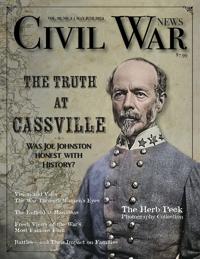
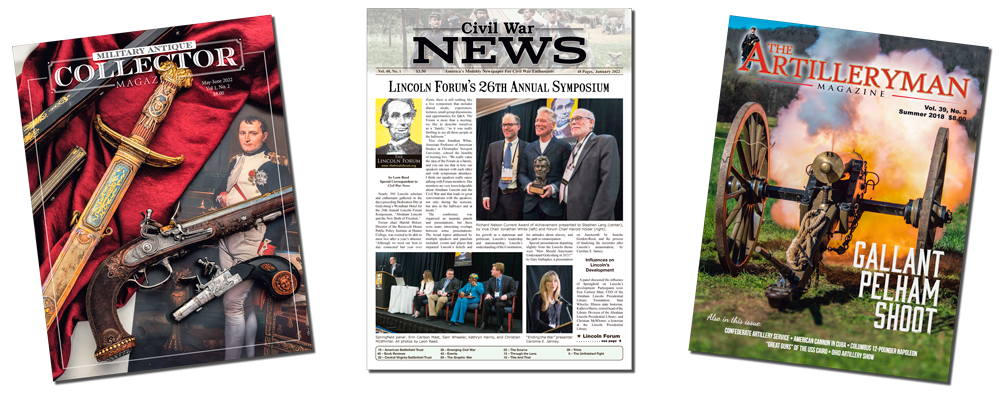
Exchange evolved into today's The Civil War News.
Today, I am told by book review editor Blake Magner, The
Civil War News publishes nearly 200 reviews a year with
a staff of 55 reviewers. And not all the books received or reviewed
are published due to space restrictions. It is estimated that
book output relating to the Civil War will top over 500 titles
this year.
Most of the major book dealers and publishers that were here
25 years ago are still around today. The used book business
is not as strong today as years past. This, I believe, is due
to the amount of new material published and the reprinting of
old titles.
Some longtime dealers have turned to publishing, like Butternut
and Blue in Baltimore and the Longstreet House in New Jersey.
Morningside Books in Dayton, Ohio, and Thomas Publications in
Pennsylvania are still major dealers and publishers.
Broadfoot Publishing Company in North Carolina reduced their
old-book inventory and went to reprinting Civil War multi-volume
ref-erence material such as the Official Records, Confederate
Veteran, History of Pennsylvania Volunteers, and the Union and
Confederate Rosters from the National Archives.
The Broadfoot Company, however, ventured into new territory
when they published a 100-volume supplement to the Official
Records. This material is reports and correspondence missed
in the original printing of the Official Records. A short
time ago Tom Broadfoot announced he was not buying book collections
and was getting out of the used book business. This caused an
uproar among his old customers and he quickly changed his mind.
Another major source of Civil War-related material are the university
presses. They continue to pump out quality material with LSU
Press and the University of North Carolina Press leading the
way. The University of Virginia and Kent State University also
publish many Civil War titles.
What is being published? Books on Lincoln and Gettysburg are
still in the forefront. Certainly much of the output today can
be labeled microhistory. New works on the first day and third
day at Gettysburg have just been released. Books that concentrate
on the fighting around the Round Tops and the faith of the Twenty-Sixth
North Carolina at Gettysburg are good examples.
Regimental histories have not been ignored. The 100-volume Virginia
Regimental History Series published by H.E. Howard of Appo-mattox
has been completed. Several excellent works on Union and Confederate
artillery have been released. There are also an abundance of
reprints of regimental histories. Some are much improved with
good introductions, rosters, photos, indexes, etc. Some not.
My personal favorites are the essay books. Major historians
sub-mit articles on specific battles and Civil War personalities.
The leader in this field is editor Dr. Gary Gallagher of the
University of Virginia. There are also many books published
on collecting Civil War relics and memorabilia. Books on reenacting
supply the needs of one of the largest and fastest growing hobbies
in America.
Much to the dismay of many there are books pro and con on the
generalship of Robert E. Lee. One major newspaper columnist
surmised that the stock in U.S. Grant is rising and Robert E.
Lee's is falling. Biographies are still being published on the
major players in the Civil War but many are of the lesser-known
personalities. Writers are looking at commanders whose reputations
were tarnished over the years in a new light. Two examples are
Joseph Harsh's works on the Maryland Campaign and General George
McClellan and Peter Cozzens's work on General John Pope. And,
one of the most gratifying trends is the amount of new material
published on the War in the West and Civil War navies. Long
overdue.
Space limits me in acknowledging all those who are contributing
to our vast knowledge of the country's most studied age. There
are hundreds of historians and writers, professional and amateur,
who - through lifelong study in some cases - have supplied us
with the material to quench our great thirst for knowledge of
the great conflict.
There are books, of course, that are just trying to cash in
on the popularity of the Civil War. These can be weeded out
by carefully reading the reviews in The Civil War News
and other major publications. Look over the book. Check the
bibliography. Is it extensive? Did the author cover all the
major repositories and works relating to the subject?
Check the acknowledgments. Did they use the resources at the
Na-tional Archives, the Library of Congress, the historical
societies and university libraries? Did they use the vast resources
of the U.S. Army Military History Institute at Carlisle Barracks
or the manuscript collections at the Civil War national battlefield
parks?
One who has read military history extensively can tell after
a short inspection if a book is worth the time and expense.
There are those who say that in the age of the internet books
are becoming obsolete. Nothing could be further from the truth.
Just check the pages of The Civil War News and other
like publications. Go into the book super stores (the downside
is the demise of the small mom-and-pop book dealer). Books will
always be with us. Just like a new car, there is nothing like
the smell of a new book or even an old one.
One last thing. I am very proud of what my little four-page
mimeographed tabloid has become. The Civil War News is
a leader in the world of Civil War publications. It all boils
down to the hard work of Pete and Kay Jorgensen and their staff
and the excellent work by book review editor Blake Magner. I
know that The Civil War News will be around for years
to come. The need is there.
Michael A. Cavanaugh is the past president of the Old Baldy
Civil War Round Table and is a member of the Board of Governors
at the Civil War Library and Museum of Philadelphia. He has
authored and co-authored five books on the Civil War, including
two Vir-ginia regimentals and a history of the 76th Pennsylvania
Infantry, the Keystone Zouaves.
He also co-authored a commanders photo guide to the battle of
Gettysburg.
He is best-known for his years of work on the July 30, 1864,
battle of the Crater, Petersburg, Va. He and William Marvel
published a book about it in 1989 for The Virginia Battles and
Leaders Series.
Mike recently compiled the previously unpublished papers of
the Pennsylvania Commandery of the Military Order of the Loyal
Legion of the United States for Broadfoot Publishing Company
and is one of the few honorary members of that organization.
Current projects include a biography of Gen. William Mahone
at the battle of Gettysburg.
He has presented numerous programs to Civil War round tables,
historic organizations, schools, and groups on the battle of
the Crater, the death of Gen. Turner Ashby, and the battle of
Cramp-ton's Gap, Sept. 14, 1862. He received the Annual Award
of Merit for his work in historic preservation from the Delaware
Valley Civil War Round Table in 1997.