
Appomattox Town & Park Eye Forgotten Battle Land
By Deborah Fitts
Feb./March 2004 APPOMATTOX, Va.
A long-forgotten battlefield from
the war's end could be preserved under a cooperative plan involving
the town of Appomattox, the Civil War Preservation Trust and
Appomattox Court House National Historical Park.
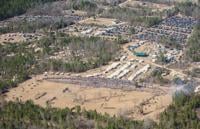
An undisturbed 47-acre portion of the battlefield of Appomattox
Station is for sale, and officials in the little town of Appomattox
are eyeing the land as a key element in a new initiative to boost
heritage tourism.
Neither the town nor the adjoining park has the money to make the
purchase, but Trust spokesman Jim Campi said his organization may
step in.
"It's in the very early stages," he said, "but we're looking forward
to working with the National Park Service and local officials to save
this site and make it into a tourist attraction."
The piece of ground north of town saw a bloody clash late on the
afternoon of April 8, 1865, when the hard-pressed Confederate army
under Robert E. Lee was brought to ground by pursuing Federals.
Five thousand Union cavalry under Gen. George A. Custer first
captured a supply train at the depot, where the town is located now.
Moving north, they surprised a column of Confederate artillery,
numbering 100 guns, under Gen. Reuben Lindsay Walker, which had gone
into bivouac on a rise of ground.
The location of the battle was long forgotten, and students of the
war assumed that the growing town had swallowed the site. But in the
1980s National Park Service historian Chris Calkins found the journal
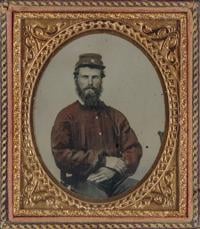
of a member of the 2nd Ohio Cavalry who had a habit of drawing
annotated maps of the actions he was in.
Calkins superimposed the trooper's sketch of the battlefield onto
period and modern maps, and located the artillery on a low knoll
fronted by swampland. Walker's command had gone in the advance of
Lee's army and halted east of Appomattox Court House in order not to
hamper the infantry, who were expected to continue moving the
Calkins got the property owner's permission to investigate the knoll,
and "lo and behold," he found friction primers, and, in the low
ground in front of the ridge, "hundreds of canister balls."
Although Calkins published his finding, little notice was taken
locally till recently, when the park began holding meetings to draft
a new General Management Plan. Calkins is on the planning team, and
raised the issue of the neglected battlefield. That caught the
attention of local officials.
"It's like all of a sudden there's this newly discovered
battlefield," Calkins said with a chuckle. Former chief of
interpretation at Appomattox, he is now a historian at Petersburg
National Battlefield and is the architect of "Lee's Retreat," the
first of the popular Civil War driving tours that have spread through
Virginia.
Appomattox Town Manager David Garrett indicated that officials were
quick to see that the battlefield could be the key element in a
fledgling effort to attract tourism.
"We don't want the land to slip out of our fingers," said Garrett.
Possible plans include a display about the battle on Main Street, a
walking trail to the battlefield, "and then we'll send them to the
National Park Service," farther to the north. An old school adjoining
the battlefield could house a museum and visitor center, Garrett said.
"We're trying to promote tourism," Garrett explained. "Instead of
visitors going to the park and staying two or three hours, we want to
try to get them to stay a couple of days." Although Garrett
acknowledged that Appomattox, population 1760, has few amenities at
present, he suggested that an influx of tourists may change that.
Park Superintendent Reed Johnson expressed hope that the Trust will
see its way to acquiring the property, which lies several hundred
yards outside the park boundary.
"You've got an extremely significant site in private hands, and we
can't do anything about it," Johnson said. "Even if the new General
Management Plan says that we should acquire it, we're two to three
years away" from making a purchase.
According to park historian Patrick Schroeder, Custer's men made four
charges against the guns, finally breaking through with the last
charge. A member of the 2nd New York Cavalry later wrote that his
unit "made a charge down a narrow lane, which led to an open field
where the rebel artillery was posted. As the charging column
debouched from the woods, six bright lights suddenly flashed before
us. A tornado of canister-shot swept over our heads, and the next
instant we were in the battery."
Schroeder said that after the battle, surgeons reported "horrific
injuries" that resulted from Federal cavalry attacking into the face
of artillery.
"It's pretty unique - cavalry assaulting batteries with no infantry
support," he said. "It's a neat story that most people don't know
much about." He added that the battlefield, which is undeveloped,
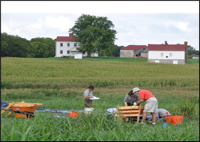
"bears a fair resemblance to the land as it was in 1865."
Custer's men tallied 100 Confederates killed or wounded and captured
25 to 30 of the guns, 100 wagons, Brig. Gen. Young Moody and 500
other Confederates.
Most importantly, Schroeder said, Custer secured the Stage Road and
now held the high ground west of Appomattox Court House, blocking
Lee's escape. That meant that Lee's only option the following day
"was to attack or surrender." Lee attacked, but the effort fell short.
"It was the action on April 8, the battle of Appomattox Station, that
determined that the surrender would take place on April 9 at
Appomattox Court House," Schroeder said. "This is the one site that
brings the strongest army in the South to its end. Somebody's got to
step in and preserve it."
Schroeder said the April 8 battlefield was not recognized when the
park was founded because "They were just interested in protecting
where the surrender took place. The actual laying down of arms was
all they were interested in."