Civil War News
For People With An Active Interest in the Civil War Today

Hooker Headquarters House At Kennesaw Mountain Threatened

By Joe Kirby

November 2005

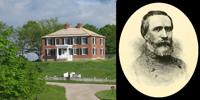
MARIETTA, GA. – A battle-scarred farmhouse used as a headquarters by Union Gen. "Fighting Joe" Hooker and later as a hospital on the eve of Sherman’s assault on Kennesaw Mountain was facing demolition as fall began.

What is shown on Sherman’s battlefield maps as the Dixon House was slated to be destroyed to make way for a five-house subdivision on the six-acre property. The county government had granted developer John Clagett of Secor Development LLC permission to raze the old structure, but then put a "hold" on the permit in mid-August after a prominent local historian, former Cobb County Commission Chairman Dr. Phil Secrist, a retired professor of Civil War history at nearby Kennesaw State University, complained.

But the "hold" was then removed after it was determined that because of the septic tank fill line on the property, the lot sizes could not be changed to save the house.

The woods surrounding the house had been bulldozed and the house itself, along with a pair of century-old oaks, was tightly surrounded by bright orange plastic fencing as September began.

The developer told the local newspaper, the Marietta Daily Journal, that he had offered the old house to two churches if they would move it, but neither had accepted it. The one-story house had been used as a church in recent decades.
Dr. Secrist told the newspaper that Clagett had offered the house to him but only if he could have it removed within two weeks.

"It wasn’t a real sincere offer," Secrist said.

The house was built in 1855 by a non-slave-holding middle-class farmer David Dickson, according to Secrist.

It stands on the west side of Acworth-Due West Road about 8 miles northwest of Marietta. That road was known during the Civil War as Sandtown Road. It originally was an Indian road leading to a Cherokee village known as Sandtown on the banks of the Chattahoochee River across from present-day Atlanta.

Sandtown Road served as a major local artery throughout the 19th century and was used by both armies both before and after the battles for Kennesaw Mountain and Atlanta.

The Dickson (Dixon) House was at roughly the center of what is known as the Gilgal Church Battlefield on June 15, 1864.

The fight was one of a number of corps-sized and division-sized actions that took place as Confederate Gen. Joe Johnston fell back from the Brushy Mountain-Lost Mountain Line to the Mud Creek Line and thence back to the main Kennesaw Mountain Line over a two-week period that month. The action at Gilgal Church took place just one day after Confederate Gen. Leonidas Polk was killed atop Pine Mountain a mile or so to the east.

The Gilgal Church battle involved U.S. Gen. Dan Butterfield’s 3rd Division of Sherman’s XX Corps commanded by Hooker and saw Butterfield push his troops southward in a reconnaissance in force toward the strategic intersection of Sandtown, Burnt Hickory and Due West roads about a mile south of the Dickson House.

There, Butterfield ran into Confederate Gen. Patrick Cleburne’s division manning a low ridge just south of the intersection. As the Federals approached Cleburne’s men hurried to Gilgal Church, which stood at the intersection, and completely dismantled it log by log and used the wood and pews to strengthen their fortifications.

Butterfield made no attempt to go around Cleburne, whose division was the westernmost infantry unit on Johnston’s line at that point, the remainder being held by dismounted cavalry. Instead, Butterfield charged his men up the hill, where they were quickly repulsed with the loss of about 200. Cleburne’s casualties were negligible.

Among the Union units taking part in the assault was the 70th Indiana Regiment commanded by Col. Benjamin Harrison, who was elected president after the war.

The Confederate victory was short-lived, as Union Gen. John Schofield’s troops on the extreme west of the Union line positioned artillery during the ensuing night that helped persuade Johnston to evacuate Lost Mountain on that end of the line and pull his west flank back toward Kennesaw Mountain.

The Dickson (Dixon) House was used as a headquarters by Hooker during the battle, according to the Official Records.

It was sold in 1920 to the father of the future Mrs. Clifton Lovinggood, who later told Secrist that the bloodstains on the floor stemmed from its use as a Federal hospital after the battle. She also showed him artillery-damaged floor joists beneath it.

In 1920 Mrs. Lovinggood’s father covered the exterior of the house with new siding and added a front and back porch in the Craftsman Style popular in that era. So good was the renovation that few local residents any idea of the house’s age until Secrist shared his knowledge with the local newspaper.

Its 20th-century appearance is likely to blame for its failure to be listed on primarily symbolic National Register of Historic Places or the more stringent Cobb County Register of Historic Places. Had it been listed on the latter, it automatically would have been protected from demolition.

A dozen acres or so of the Gilgal battlefield was purchased by the late Sydney C. Kerksis, a retired Army officer, in the 1960s and donated after his death in the late 1980s to Cobb County for a local park. Kerksis was a well-known relic hunter and author of Civil War reference and other works.

Historical Publications Inc.
234 Monarch Hill Rd.
Tunbridge VT 05077

Our email address is: mail@civilwarnews.com

Subscriptions: (800) 777-1862
Free Sample: (800) 777-1862
Display Ads: (800) 777-1862
Editorial: (802) 889-3500
Fax: (802) 889-5627