
Preservationists Celebrate ‘Flank Attack’ Site, Virginia Bill
By Scott C. Boyd
(June 2010 Civil War News)
SPOTSYLVANIA COUNTY, Va. - “The ground we are looking at here is truly special and unique. It is not only where men fought with determination and died. It is a piece of ground that witnessed one of the most celebrated events in all of military history, Stonewall Jackson’s Flank Attack, which resonates through time and space and is still relevant today as it was in 1863.”

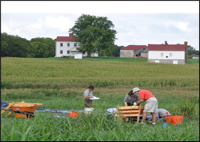
NPS historian Frank O’Reilly gives a riveting account of the fighting at what is today the Wagner Farm at Chancellorsville. A ceremony marked the preservation of the 85-acre farm where Stonewall Jackson’s famous Flank Attack struck the Union lines. (Scott C. Boyd photo) |
National Park Service (NPS) historian Frank O’Reilly spoke those words as he led a tour of the Wagner Farm at Chancellorsville following a ceremony marking the Civil War Preservation Trust’s (CWPT) acquisition of the property.
The April 20 Wagner Farm ceremony featured Virginia Governor Robert F. McDonnell and a host of government and private sector preservation leaders. At its conclusion McDonnell signed legislation creating the Virginia Civil War Sites Preservation Fund, a permanent fund for Civil War battlefields.
“This farm here, Wagner Farm, and its 85 acres that were preserved in a land preservation agreement reached just last year in December, is an important part of our efforts to maintain our Civil War battlefields here in Virginia,” McDonnell said.
The commonwealth provided a $706,000 matching grant towards the $2.1 million price. The balance came from a $500,000 federal transportation enhancement grant and $900,000 raised by CWPT.
McDonnell spoke of preserving other land in addition to historic properties when he commended his immediate predecessor, Timothy M. Kaine, for achieving the goal of preserving 400,000 acres of open space land during his four-year term in office. McDonnell vowed to do the same during his term that ends in January 2014.
Douglas W. Domenech, Virginia Secretary of Natural Resources, said, “As Virginia’s population continues to grow, we cannot underestimate the benefits these open spaces will provide to our citizens and communities in the future, and their role in keeping Virginia an attractive state in which to visit and play or live and raise a family and do business.”
The program’s focus was on battlefield preservation. Virginia Speaker of the House of Delegates William J. Howell outlined the challenge.
“Each day we lose about 30 acres of battlefields to development — every single day,” he said. Howell noted the CWPT has saved more than 14,000 acres of Virginia battlefield property and the Shenandoah Valley Battlefields Foundation (SVBF) has saved over 3,000 acres.
“It’s estimated that there are approximately 50,000 acres of battlefields that remain to be preserved in Virginia, and that’s a staggering thought,” he said, “because as we all know, land preservation is not cheap.”
Howell struck an optimistic and timely note, however, when he said, “Virginia has taken great steps in making this affordable.”
One of those steps to encourage battlefield conservation is the Virginia Civil War Sites Preservation Fund that both houses in the General Assembly unanimously supported. Its funds will be appropriated to private sector entities on a one-to-one matching basis.
“Virginia is the only state with a permanently established fund specifically for Civil War battlefields,” according to Mary Koik, CWPT’s Deputy Director of Communications. “Other states have, in the past, done one-time allocations, but this is the only one of its kind.”
Governor McDonnell signed the legislation while seated between the bill’s sponsors, state Delegate Chris Peace (Hanover County) and state Senator Edd Houck (Spotsylvania County).
McDonnell also gave poster-size checks from the state for new preservation grants to CWPT President James Lighthizer and SVBF Executive Director Denman Zirkle.
The CWPT received $205,693 for five properties: Glendale (Henrico County), Reams Station (Dinwiddie County), Ware Bottom Church (Chesterfield County), Manassas (Prince William County) and Williamsburg (City of Williamsburg).
The SVBF received $94,478 for two properties: Cedar Creek (Warren County) and Fisher’s Hill (Shenandoah County).
Kathleen S. Kilpatrick, whom McDonnell announced he had reappointed as Director of Virginia’s Department of Historic Resources, hosted the ceremony.
She acknowledged the preservation groups in attendance: The NPS, Preservation Virginia, Central Virginia Battlefields Trust, Friends of Fredericksburg Area Battlefields, Piedmont Environmental Council of Virginia, Spotsylvania Preservation Foundation, Brandy Station Foundation, National Trust for Historic Preservation, Friends of Wilderness Battlefield, Journey Through Hallowed Ground and Richmond Battlefields Association.
Preservation of the Wagner Farm would not have been possible without the cooperation of the landowners. McDonnell thanked Dr. and Mrs. Frank Wagner, who acquired the land in 1984, and previous owners, Carlton and Shirley Onderdonk.
Under their agreement with CWPT, the Wagners will continue to live and farm on the land. Dr. Wagner, a veterinarian, raises cattle and Margot Wagner has horses on the 85 acres.
“We bought the land for the sole purpose of farming it,” she said in an interview. “We’ll be here for a long, long time, and continue to work the farm and maintain the property, so it’s safe and in good shape.”
Wagner said being able to stay on the farm was one of the reasons they were able to reach an agreement with CWPT. “It was a big decision for us to sell the farm at this stage,” she said, although the couple always thought they would like to see the farm preserved.
“Having the people here and seeing how much how many people enjoyed being on the property confirmed we had made the right decision. That was the most meaningful thing for me,” she said.
The property will not be open to the public except on special occasions, such as the brief tour O’Reilly conducted.
|