No Longer ‘Known But To God’
By Joe Kirby
(July 2010 Civil War News)
Brad Quinlin researches the identities of unknown soldiers buried in Marietta National Cemetery. (Courtesy Marietta Daily Journal)
|
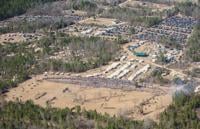
MARIETTA, Ga. — Marietta National Cemetery is the final resting place for 10,312 Union casualties of the Civil War, 3,048 of them buried as “unknowns.” Now 16 of those men, whose identities were “known but to God,” have been identified thanks to local Civil War historian and researcher Brad Quinlin.
Quinlin said his identifications are “not guesswork — this is all from documentation.”
Over the past nine years he has used such information as where the soldiers were originally buried, where their units were from day to day, and rosters of the dead from each regiment in Sherman’s army to extrapolate the identities of the unknowns.
Even more important are records kept by the U.S. Army just after the war as it exhumed remains from the Northwest Georgia battlefields and hospitals where they had fallen and been hastily buried. Their remains then were transported to a spacious new military cemetery on 23 acres donated for that purpose by Henry Cole on a hilltop due east of downtown Marietta.
Cole — a Marietta businessman who was a Union sympathizer jailed by the Confederates as a spy — gave the land as a gesture of reconciliation in hopes it would be used for the fallen of both sides. But the town’s residents, many of them no doubt embittered by the war, chose to continue to have Confederate remains buried in what is now the Marietta Confederate Cemetery, where burials had begun in 1863.
The Union burial parties kept meticulous records (now housed in the National Archives in Washington, D.C.) with the description of each set of remains, including any identifying details and where they were found.
One such notation helped Quinlin identify a young soldier who died at a Marietta hospital set up in the First Baptist Church. He first was buried a few yards away from the church, then moved to the national cemetery. The reburial records noted a ring with the inscription, “From E.P. to J.P., With Love.”
Using information about the makeshift graveyard and which units had used the hospital, and having a roster of those units’ casualties, Quinlin deduced that “J.P.” was James Painter of the 21st Ohio Infantry Regiment —coincidentally the reenactment unit of which Quinlin is a member.
Further research showed that he was given the ring at the outset of the war by his sister, Elizabeth. Quinlin then located Painter’s great-great-granddaughter, who provided a photo of Painter in uniform, with the ring clearly visible on his finger.
The first of the unknowns Quinlin identified was another member of the 21st Ohio. Quinlin had been compiling a list of unit soldiers killed during the Atlanta Campaign and where each was buried, but could not find that information for several of them.
He essentially cross-referenced roster information with knowledge of where the unit was each day, burial notations (when available), which unit the deceased was thought to have been a member of, and, where available, the deceased’s initials.
He now has expanded his research to include each regiment of Sherman’s army during the Atlanta Campaign.
“There was an incredible level of detail written down on the part of those who compiled the burial records,” Quinlin said. “It’s almost like they hoped and prayed that someone down the road would be able to identify these men.”
Another example: a Union soldier disinterred from a grave on the Kennesaw Mountain battlefield was discovered to have been buried with a torn piece of paper stuffed in his pocket, which read, “A.H., Co. B., 113th Ohio.” The man was then reburied in Grave 9308 in the National Cemetery as an unknown.
Quinlin’s process of elimination showed the only soldier from that unit killed near the spot in question was Pvt. Adam Hissong.
Quinlin’s efforts have proven the identities of the following “unknowns” who are buried in Marietta National Cemetery: Pvt. James Forrest, 21, killed at the Battle of Pickett’s Mill; Pvt. George Deal of the 20th Ohio, killed July 22, 1864, near Atlanta and first buried near the Troup Hurt House;
Also John W. Carter, Freeman Dulin, Lorenzo Kates, Michael O’Connell, Eugene H. Palin and Andrew J. Rhodes, all privates with the 113th Ohio who were killed in the Cheatham Hill area June 27, 1864, during the Battle of Kennesaw Mountain.
Another was Pvt. James Clymer, 21st Ohio, age 17, who died of “dropsy” in a temporary hospital near the Confederate cemetery three months after the battle. His grave now has a headstone.
“After finding the first one, I realized that many more could be identified, so anytime I had the time to work on it during the past nine years, I did,” Quinlin said.
“I can’t tell you how many times I’ve been to [Washington] D.C., to look at the old records. If I can keep my focus and make enough trips back to D.C., I could probably do the documentation for 200 of the unknowns.”
Celebrities
When producers of NBC’s “Who Do You Think You Are?” were trying to find the remains of actor Matthew Broderick’s Civil War ancestor they contacted Willie Ray Johnson, park historian at Kennesaw Mountain Battlefield Park.
He, in turn, steered them to Quinlin, who researched what had befallen Broderick’s great-great-grandfather, Robert Martindale, a soldier in the 20th Connecticut Regiment.
It turns out that Martindale was hit in the head by a Confederate sniper’s minie ball during the Battle of Peachtree Creek on July 23, 1864, in Atlanta. He was buried in a makeshift cemetery adjacent to the Western & Atlantic Railroad tracks along with 25 other recent Union casualties.
Quinlin found the burial locations of all of the men of the 20th Connecticut who were killed during the Atlanta Campaign — except one. The 1866-67 burial log noted that one of those 25 temporary burials was an unknown soldier of the 20th. By the process of elimination, Quinlin determined he was Martindale.
The soldier now lies in Section D, Grave 2469 of the Marietta cemetery, where Broderick, Quinlin and a camera crew paid a respectful visit last winter.
Quinlin is a familiar face at Kennesaw Mountain National Battlefield Park, where he has been a volunteer living history interpreter for years. He and his reenactment unit also struck up a friendship with then-Vice President Dick Cheney whose ancestor in the 21st Ohio took part in the battles of Chickamauga and Kennesaw Mountain.
Quinlin gave Cheney two “hush-hush” tours of Chickamauga and one of Kennesaw Mountain while he was in office, and Quinlin’s unit marched in the January 2005 Inaugural Parade.
His research nearly came to a permanent halt this past year when Quinlin unexpectedly contracted a severe case of spinal meningitis, which went into his brain and caused encephalitis, nearly killing him. He suffered severe damage to the right side of his brain and is only now on the verge of being able to resume his job as a guide.
“God saved me for a reason, and I think it was to continue my research,” he said.
Quinlin has submitted his documentation to the Veterans Administration and expects the “unknown” and blank markers eventually to be replaced with headstones bearing the men’s names. That was the process when Athens historian and author David Evans (Sherman’s Horsemen) a decade ago identified four Union cavalrymen buried in the cemetery as unknowns.
Thanks to the efforts of Quinlin and Evans, the ranks of the unknowns at Marietta National Cemetery have been thinned to 3,028 from 3,048. That’s 20 more men whose identities now are known to all of us — not just to God.
A follow-up story will tell about five of the unknowns who have been identified as members of the U.S. Colored Troops.
|