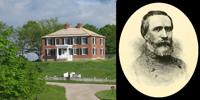


Lutheran Seminary Cupola To Open Twice A Year

By Deborah Fitts


GETTYSBURG, Pa. — Among the Meccas for Civil War aficionados, few things are more elusive than a visit to the famous cupola at the Lutheran Theological Seminary. Now, for the first time in the history of the 1832 building, twice-yearly organized public tours will be offered starting Nov. 18.

“One of my greatest hopes has been to get the cupola open,” says Wayne Motts, who has served as executive director of the Adams County Historical Society for the last year and a half. “Every day somebody comes and knocks on the door and wants to see the cupola.”

Around 7 a.m. on July 1, 1863, it was from this high vantage point atop the Gettysburg Seminary’s main building — which stands atop Seminary Ridge — that Union cavalry commander Gen. John Buford spotted the Confederate army advancing on Gettysburg from the west. The war’s greatest battle would ensue.

Schmucker Hall, known formerly the “Old Dorm,” or, at the time of the battle, “the Edifice,” served for six decades as the seminary’s only building. It still stands at the heart of the campus, but since 1959 the entire building has been leased to the historical society. Now Motts has repaired the shaky steps to the cupola, cleaned out the building’s attic, and solved liability problems, making the tours possible.

The experience won’t come cheap. Motts is asking $125 per person for non-members of the society or seminary, and $100 a head for members and for groups with a minimum of 10 people. The proceeds will go to the society and to the seminary’s own nonprofit group, the Seminary Ridge Historic Preservation Foundation. The seminary leases the building to the historical society for $1 a year.

Visitors will climb several flights of steps to reach the attic. With five stories commanding the ridge, in 1863 the building stood higher than any other in town. It was a magnet for the Union leadership, who were first on the scene at Gettysburg and eager to learn the enemy’s whereabouts.

“What you’re walking on here is what Buford walked on,” says Motts, as he leads a reporter across the tidy attic floor. The Civil War News is the first Civil War publication to visit the cupola, he notes, as he climbs a final flight of steps at the middle of the attic floor and throws open a hatch.

Here’s where the actual 1863 fabric ends: In August 1913 lightning struck the cupola and it burned. The seminary built an identical replacement, fastening old wood to new partway down the steps.

The cupola still offers one of the most breathtaking views in Gettysburg. Motts points out some landmarks. In the distance rises the blue bulk of South Mountain, and there’s the gap at Cashtown pass whence the Confederates came.

Motts made a practice run for the tour in April, attracting 100 visitors without even advertising. Because of close quarters in the cupola, the size of each tour group will be limited to eight to 10. Each group will have an hour-long tour, with 15 minutes in the cupola itself.

The rest of the time will be devoted to historical information, and there’s plenty to learn. Schmucker Hall has changed little since July 1863, when it was the first field hospital at Gettysburg, taking in both Union and Confederate wounded on July 1. Troopers from Buford’s command were among the first patients.

Confederates occupied the building from July 1 to 4, with Confederate and Union surgeons working together. The structure continued to harbor wounded till the middle of September.

Nowadays it holds the massive collection of the Adams County Historical Society. The 42,000 cubic feet of paper in their files include official county records, manuscripts and diaries from the county’s history, from 1800 to the present.

The society has 20,000 artifacts, including a bullet-riddled shop sign from the square in Gettysburg and a table from the Lydia Leister House, where Union Gen. George Meade conferred with his top officers. There are nearly 3,000 historic battlefield photos, 1,000 of them by renowned local photographer William Tipton.

“The Civil War is a small part” of all that the society has, but its Civil War holdings are significant and “very much under-utilized,” according to Motts. They include 18 binders of civilian accounts of the battle. The society’s extensive museum, occupying two floors of the building, is open by appointment

At the time of the battle, the front door was on the east side of the building, opposite where it is now, and there was no road on the west side, where the road is now. A Union defensive perimeter was set up just west of the building. On the afternoon of July 1 Confederates under Dorsey Pender punched a hole through the Federal defenses at the south end of the building. The colonel commanding the 151st Pennsylvania Volunteers was shot in both legs and carried inside.

According to Motts, the society has such detailed accounts of wounded in the building “that in some cases we know the room” where they stayed.

Eventually Motts would like to rehabilitate Schmucker Hall and open it as a museum, while moving the historical society’s offices elsewhere. The society’s $200,000 budget covers two full-time and four part-time employees. The county chips in $12,000 and the state another $10,000, but Motts says most of the money comes from memberships, donations and sales of maps and publications. (Member numbers have risen from 300 four years ago, to 1,100 today.) Fifty volunteers donate 8,000 hours a year to the society, cataloging and scanning items.

Motts plans to offer the cupola tours in the spring and fall, when leaves are off the trees and the view is unobscured. Tour-goers on Nov. 18 will learn about the tide of battle around Schmucker Hall, see some of the Civil War items, hear the building’s history — and of course visit the cupola.

Motts is accepting registrations via e-mail at info@achs-pa.org or by phone at (717) 334-4723.