
Richmond Park Adds 'Rural Plains' As New 124-Acre Battlefield

By Deborah Fitts

RICHMOND, Va. — A wartime structure with an unparalleled historic pedigree and 124 battlefield acres were donated to Richmond National Battlefield Park in ceremonies June 1 that drew a crowd of about 150.

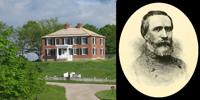
Rural Plains, a brick house in Hanover County, and the Totopotomoy Creek battlefield now comprise the park’s 13th unit. The property, on Studley Road in Mechanicsville, in eastern Hanover County, lies about 10 miles north of Cold Harbor.

Park Superintendent Cynthia MacLeod hailed the gift, made by a private group dubbed the Totopotomoy Battlefield at Rural Plains Foundation. Preservation of the property was spearheaded by Andy Shield, a local developer with an interest in history.

“The donation was magnificent,” said MacLeod. “It’s a real contribution to American history. We’re very grateful.”

The purchase price for the home and land was $1.2 million, according to Civil War Preservation Trust (CWPT) spokesman Jim Campi. CWPT kicked in $200,000, the American Battlefield Protection Program provided $87,500 in federal battlefield funds, and Hanover County also gave to the cause.

Rural Plains is the ancestral home of the Shelton family. According to Hanover County tradition, Patrick Henry married Sarah Shelton in the house in 1754. On May 30, 1864, Union and Confederate troops clashed on the property, in a prelude to Cold Harbor. Union Gen. Winfield Scott Hancock made his headquarters in the house, and a signal station on the roof attracted Southern fire, with 51 artillery shells striking the building that day.

The last family descendant, William R. Shelton Jr., who had no children, agreed to make Rural Plains available for preservation. Shield and his foundation arranged for the acquisition, raised funds and handed the property over to the park.

Shelton died at 85 on May 5, missing the hand-over celebration by less than a month. He had sold the property to the foundation in 2001 but had a life estate.

Among those on hand June 1 was Robert Bluford, director of the Douglas Southall Freeman Branch of the Association for the Preservation of Virginia Antiquities. It was Bluford who suggested preservation of Rural Plains to Shield, who was setting out to develop the area.

 Shield said he was pleased to save Rural Plains, on account of its rich history. He recalled that the house was built in 1667-70 from glazed bricks brought in a ship’s hold from England by the first Shelton to this country. A later Shelton left Rural Plains to fight and die on the Brandywine battlefield, in the Revolutionary War. And Shield said soldiers from 11 northern and three southern states fought on the land in 1864.

“This is truly a unique property,” said Shield, noting that it was handed down from father to son for nine generations. The original 5,000 acres was given as a king’s grant in the 17th century. The house has been altered little over the years, he said.

Shield declined to confirm the purchase price or detail where the funding came from, although he acknowledged that some of the money was his own.

“I did not do it for anything other than it was the right thing to do,” he said.

The park’s only expense in the hand-over was the purchase of about three dozen items from the house, including books and several pieces of furniture that were believed to have been present in 1864. Shelton assisted the park in selecting items from the period, according to MacLeod, who said he was very knowledgeable about the provenance of the furnishings. Among the items the park bought were a Sheraton dining room table, an Empire bureau, a couple of tables, and an 18th-century cupboard. They will remain with the home.

MacLeod noted that the park has no funds allocated for Rural Plains, and consequently public access and interpretation will be limited for the foreseeable future. In a first phase, the park is seeking volunteers for trail construction, and later will seek assistance for house tours. The park also hopes to conduct research on Rural Plains, and eventually create a development concept plan to manage the new park unit.

“The house is spectacular, the grounds are beautiful,” said MacLeod. The property, partly wooded and partly in fields, fronts Totopotomoy Creek and has Confederate earthworks that Supervisory Park Ranger Mike Andrus described as “primarily in pristine condition.”

Fighting near the house began May 29, 1864, and lasted into May 31, according to Andrus, as Union Gen. U.S. Grant attempted to feel his way around the Confederate army under Robert E. Lee. Grant’s bloody campaign had already seen clashes at the Wilderness, Spotsylvania and North Anna.

At Totopotomoy Creek, Lee dug in along the stream and set up a strong defensive position. Grant probed for weakness, but eventually moved on to Cold Harbor and some of the war’s bloodiest fighting.

A rezoning of 457 acres by Hanover County in 2000 led to Shield’s ability to develop residential housing while preserving the 124-acre tract at Rural Plains. In 1996 the park had identified the property for inclusion within the battlefield boundary, and congressional legislation added the land in 2000.

On June 1 a tent was set up in the yard of the home for the ceremony. Among the speakers was Jim Lighthizer, president of the Civil War Preservation Trust. Lighthizer said he was “proud” to be part of a partnership that included preservation groups, local government and the private sector. “The site could not have been saved” without all the parties working together, he said.